EPUB · English
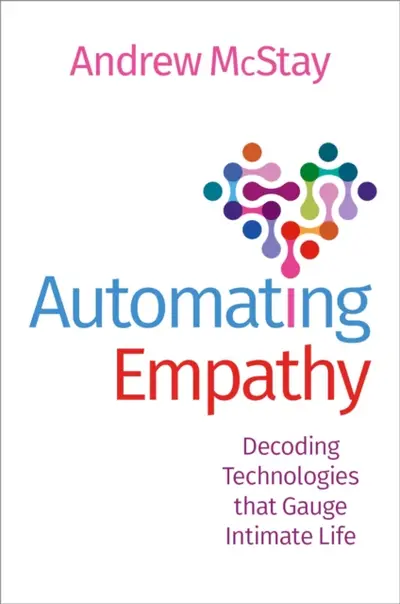
Automating Empathy
Decoding Technologies that Gauge Intimate Life
Price and availability
$24.99
Available in: Andorra, Austria, Australia, Belgium, Bulgaria, Canada, Switzerland, Cyprus, Czechia, Germany, Denmark, Estonia, Spain, Finland, France, United Kingdom, Guernsey, Greece, Croatia, Hungary, Ireland, Isle of Man, Iceland, Italy, Jersey, Japan, Liechtenstein, Lithuania, Luxembourg, Latvia, Monaco, Malta, Netherlands, Norway, Poland, Portugal, Romania, Sweden, Slovenia, Slovakia, San Marino, United States, Vatican City, South Africa
Stores: US, UK, Canada, EU, Australia.
Sign in to buyThe price is re-checked by the server before payment.
For personal use under the eBook licence.
- Format
- EPUB
- DRM
- Not stated by the publisher
- Language
- English
- Publisher
- Oxford University Press
- Published
- 17 October 2023
- ISBN
- 9780197615577
- Subjects
- Cultural studies, Sociology: customs & traditions, Technology: general issues, Artificial intelligence, Natural language & machine translation, JBCC, JHB, Technology: general issues, Artificial intelligence (AI), Natural language and machine translation
About this book
This is an open access title. It is made available under a Creative Commons Attribution-Non Commercial-No Derivatives 4.0 International license. It is available to read and download as a PDF version on the Oxford Academic platform.We live in a world where artificial intelligence and intensive use of personal data has become normalized. Companies across the world are developing and launching technologies to infer and interact with emotions, mental states, and human conditions. However, the methods and means of mediating information about people and their emotional states are incomplete and problematic. Automating Empathy offers a critical exploration of technologies that sense intimate dimensions of human life and the modern ethical questions raised by attempts to perform and simulate empathy. It traces the ascendance of empathic technologies from their origins in physiognomy and pathognomy to the modern day and explores technologies in nations with non-Western ethical histories and approaches to emotion, such as Japan. The book examines applications of empathic technologies across sectors such as education, policing, and transportation, and considers key questions of everyday use such as the integration of human-state sensing in mixed reality, the use of neurotechnologies, and the moral limits of using data gleaned through automated empathy. Ultimately, Automating Empathy outlines the key principles necessary to usher in a future where automated empathy can serve and do good. Drawing insights across ethics, philosophy, and policy, Automating Empathy argues for a pluralistic reconceptualization of empathic technologies to better reflect the intimate dimensions of human life.
Bibliographic data © Gardners Books Ltd.