EPUB · English
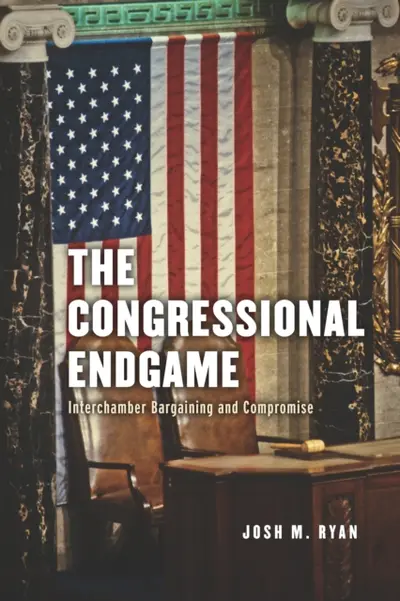
Congressional Endgame
Interchamber Bargaining and Compromise
Price and availability
$47.99
Available in: Andorra, Austria, Australia, Belgium, Bulgaria, Canada, Switzerland, Cyprus, Czechia, Germany, Denmark, Estonia, Spain, Finland, France, United Kingdom, Guernsey, Greece, Croatia, Hungary, Ireland, Isle of Man, Iceland, Italy, Jersey, Japan, Liechtenstein, Lithuania, Luxembourg, Latvia, Monaco, Malta, Netherlands, Norway, Poland, Portugal, Romania, Sweden, Slovenia, Slovakia, San Marino, United States, Vatican City, South Africa
Stores: US, UK, Canada, EU, Australia.
Sign in to buyThe price is re-checked by the server before payment.
For personal use under the eBook licence.
- Format
- EPUB
- DRM
- Not stated by the publisher
- Language
- English
- Publisher
- University of Chicago Press
- Published
- 26 October 2018
- ISBN
- 9780226582375
- Subjects
- USA, Politics & government, Political structure & processes, Central government, Politics and government, Political structure and processes, Central / national / federal government
About this book
Congress is a bicameral legislature in which both the House and Senate must pass a bill before it can be enacted into law. The US bicameral system also differs from most democracies in that the two chambers have relatively equal power to legislate and must find ways to resolve their disputes. In the current landscape of party polarization, this contentious process has become far more chaotic, leading to the public perception that the House and Senate are unwilling or unable to compromise and calling into question the effectiveness of the bicameral system itself. With The Congressional Endgame, Josh M. Ryan offers a coherent explanation of how the bicameral legislative process works in Congress and shows that the types of policy outcomes it produces are in line with those intended by the framers of the Constitution. Although each bargaining outcome may seem idiosyncratic, the product of strong leadership and personality politics, interchamber bargaining outcomes in Congress are actually structured by observable institutional factors. Ryan finds that the characteristics of the winning coalition are critically important to which chamber "e;wins"e; after bargaining, with both conference committees and an alternative resolution venue, amendment trading, creating policy that approximates the preferences of the more moderate chamber. Although slow and incremental, interchamber negotiations serve their intended purpose well, The Congressional Endgame shows; they increase the odds of compromise while at the same time offering a powerful constraint on dramatic policy changes.
Bibliographic data © Gardners Books Ltd.