PDF · English
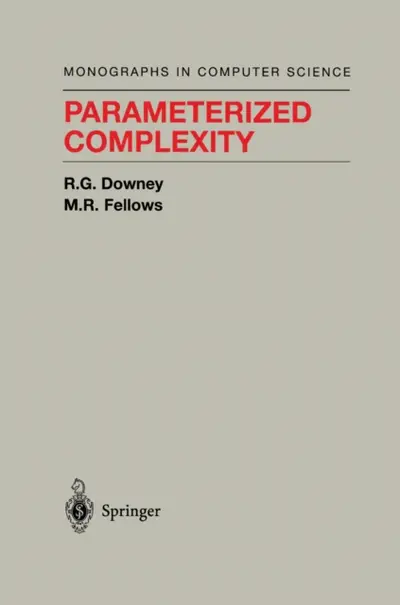
Parameterized Complexity
Price and availability
$296.99
Available in: Andorra, Austria, Australia, Belgium, Bulgaria, Canada, Switzerland, Cyprus, Czechia, Germany, Denmark, Estonia, Spain, Finland, France, United Kingdom, Guernsey, Greece, Croatia, Hungary, Ireland, Isle of Man, Iceland, Italy, Jersey, Japan, Liechtenstein, Lithuania, Luxembourg, Latvia, Monaco, Malta, Netherlands, Norway, Poland, Portugal, Romania, Sweden, Slovenia, Slovakia, San Marino, United States, Vatican City, South Africa
Stores: US, UK, Canada, EU, Australia.
Sign in to buyThe price is re-checked by the server before payment.
For personal use under the eBook licence.
- Format
- DRM
- Not stated by the publisher
- Language
- English
- Publisher
- Springer New York
- Published
- 6 December 2012
- ISBN
- 9781461205159
- Subjects
- Mathematical foundations, Mathematical logic, Discrete mathematics, Applied mathematics, Algorithms & data structures, Computer science, Mathematical theory of computation, Mathematical foundations, Mathematical logic, Discrete mathematics, Applied mathematics, Algorithms and data structures, Mathematical theory of computation
About this book
The idea for this book was conceived over the second bottle of Villa Maria's Caber- net Medot '89, at the dinner of the Australasian Combinatorics Conference held at Palmerston North, New Zealand in December 1990, where the authors first met and discovered they had a number of interests in common. Initially, we embarked on a small project to try to formulate reductions to address the apparent parame- terized intractability of DOMINATING SET, and to introduce a structure in which to frame our answers. Having spent several months trying to get the definitions for the reductions right (they now seem so obvious), we turned to our tattered copies of Garey and Johnson's work [239]. We were stunned to find that virtually none of the classical reductions worked in the parameterized setting. We then wondered if we'd be able to find any interesting reductions. Several years, many more bottles, so many papers, and reductions later it [3] seemed that we had unwittingly stumbled upon what we believe is a truly central and new area of complexity theory. It seemed to us that the material would be of great interest to people working in areas where exact algorithms for a small range of parameters are natural and useful (e. g. , Molecular Biology, VLSI design). The tractability theory was rich with distinctive and powerful techniques. The intractability theory seemed to have a deep structure and techniques all of its own.
Bibliographic data © Gardners Books Ltd.