PDF · English
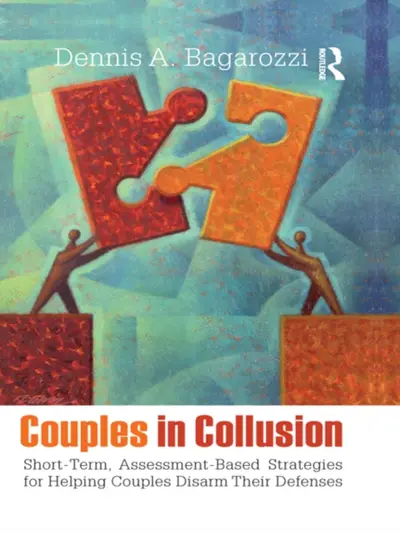
Couples in Collusion
Short-Term, Assessment-Based Strategies for Helping Couples Disarm Their Defenses
Price and availability
$45.99
Available in: Andorra, Austria, Australia, Belgium, Bulgaria, Canada, Switzerland, Cyprus, Czechia, Germany, Denmark, Estonia, Spain, Finland, France, United Kingdom, Guernsey, Greece, Croatia, Hungary, Ireland, Isle of Man, Iceland, Italy, Jersey, Japan, Liechtenstein, Lithuania, Luxembourg, Latvia, Monaco, Malta, Netherlands, Norway, Poland, Portugal, Romania, Sweden, Slovenia, Slovakia, San Marino, United States, Vatican City, South Africa
Stores: US, UK, Canada, EU, Australia.
Sign in to buyThe price is re-checked by the server before payment.
For personal use under the eBook licence.
- Format
- DRM
- Not stated by the publisher
- Language
- English
- Publisher
- Taylor & Francis
- Published
- 26 July 2012
- ISBN
- 9781136518928
- Subjects
- Psychological testing & measurement, Psychotherapy, Couple and Family psychology, Psychotherapy: couples and families
About this book
When a couple enters therapy, both partners have either explicit or implicit understandings of what can-and, more importantly, cannot-be discussed in therapy. Even when empirically tested assessments are used to help pinpoint areas of concern and conflict, couples may choose to identify only those areas that are relatively safe and do not seriously threaten each partner's sense of integrity and vulnerability. How is a therapist supposed to proceed when a couple comes in for a tune-up, not realizing that their entire transmission needs to be serviced? Therapists know that some relationships, like some transmissions, can continue to function on some level even without proper care-sometimes even for years-before the couple seeks therapy. If, when they come in, the therapist can help the couples to repair and regain their lost equilibrium, they'll be more likely to seek help when the transmission next begins to slip. In its clear, precise prose, insightful case studies, and thought-provoking discussion questions, Couples in Collusion lays out guidelines for identifying, understanding, and, dealing with the unspoken agreements and collusive systems that couples build up over time. Clinicians will find each chapter replete with concrete strategies they can use in practice as well as thorough explanations of the assessment tools, suggestions on how to use them, and even advice on how to build the tools' costs into clinicians' limited budgets.
Bibliographic data © Gardners Books Ltd.