PDF · English
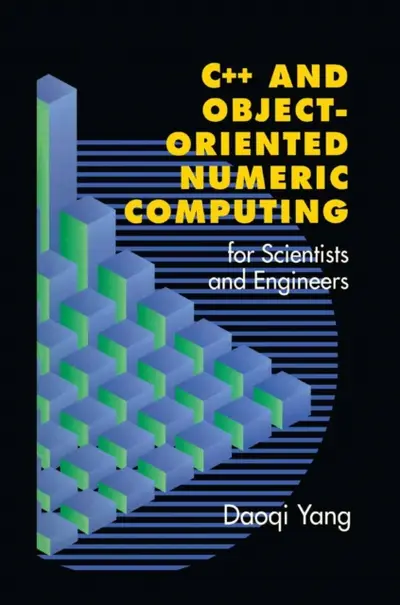
C++ and Object-Oriented Numeric Computing for Scientists and Engineers
Price and availability
$74.99
Available in: Andorra, Austria, Australia, Belgium, Bulgaria, Canada, Switzerland, Cyprus, Czechia, Germany, Denmark, Estonia, Spain, Finland, France, United Kingdom, Guernsey, Greece, Croatia, Hungary, Ireland, Isle of Man, Iceland, Italy, Jersey, Japan, Liechtenstein, Lithuania, Luxembourg, Latvia, Monaco, Malta, Netherlands, Norway, Poland, Portugal, Romania, Sweden, Slovenia, Slovakia, San Marino, United States, Vatican City, South Africa
Stores: US, UK, Canada, EU, Australia.
Sign in to buyThe price is re-checked by the server before payment.
For personal use under the eBook licence.
- Format
- DRM
- Not stated by the publisher
- Language
- English
- Publisher
- Springer New York
- Published
- 28 June 2011
- ISBN
- 9781461301899
- Subjects
- Cybernetics & systems theory, Numerical analysis, Mathematical physics, Maths for engineers, Computer programming / software development, Compilers, Cybernetics and systems theory, Numerical analysis, Mathematical / Computational / Theoretical physics, Maths for engineers, Computer programming / software engineering, Compilers and interpreters
About this book
This book is intended to be an easy, concise, but rather complete, introduc- the ISO/ANSI C++ programming language with special empha- tion to sis on object-oriented numeric computation for students and professionals in science and engineering. The description of the language is platform- independent. Thus it applies to different operating systems such as UNIX, Linux, MacOS, Windows, and DOS, as long as a standard C++ compiler is equipped. The prerequisite of this book is elementary knowledge of cal- culus and linear algebra. However, this prerequisite is hardly necessary if this book is going to be used as a textbook for teaching C++ and all the sections on numeric methods are skipped. Programming experience in an- other language such as FORTRAN, C, Ada, Pascal, Maple, or Matlab will certainly help, but is not presumed. All C++ features are introduced in an easy way through concepts such as functions, complex numbers, vectors, matrices, and integrals, which are familiar to every student and professional in science and engineering. In the final chapter, advanced features that are not found in FORTRAN, C, Ada, or Matlab, are illustrated in the context of iterative algorithms for linear systems such as the preconditioned conjugate gradient (CG) method and generalized minimum residual (GMRES) method. Knowledge of CG, GMRES, and preconditioning techniques is not presumed and they are ex- plained in detail at the algorithmic level.
Bibliographic data © Gardners Books Ltd.