EPUB · English
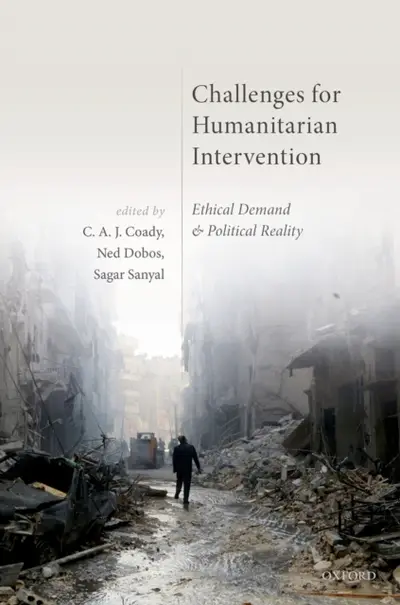
Challenges for Humanitarian Intervention
Ethical Demand and Political Reality
Price and availability
$77.99
Available in: Andorra, Austria, Australia, Belgium, Bulgaria, Canada, Switzerland, Cyprus, Czechia, Germany, Denmark, Estonia, Spain, Finland, France, United Kingdom, Guernsey, Greece, Croatia, Hungary, Ireland, Isle of Man, Iceland, Italy, Jersey, Japan, Liechtenstein, Lithuania, Luxembourg, Latvia, Monaco, Malta, Netherlands, Norway, Poland, Portugal, Romania, Sweden, Slovenia, Slovakia, San Marino, United States, Vatican City, South Africa
Stores: US, UK, Canada, EU, Australia.
Sign in to buyThe price is re-checked by the server before payment.
For personal use under the eBook licence.
- Format
- EPUB
- DRM
- Not stated by the publisher
- Language
- English
- Publisher
- Oxford University Press
- Published
- 10 May 2018
- ISBN
- 9780192542144
- Subjects
- Ethics & moral philosophy, Social & political philosophy, Political science & theory, International relations, Geopolitics, Theory of warfare & military science, International human rights law, International humanitarian law, Political science and theory, Geopolitics, Theory of warfare and military science, Public international law: human rights, Public international law: humanitarian law, Ethics and moral philosophy, Social and political philosophy
About this book
Ten new essays critique the practice armed humanitarian intervention, and the 'Responsibility to Protect' doctrine that advocates its use under certain circumstances. The contributors investigate the causes and consequences, as well as the uses and abuses, of armed humanitarian intervention. One enduring concern is that such interventions are liable to be employed as a foreign policy instrument by powerful states pursuing geo-political interests. Some of the chapters interrogate how the presence of ulterior motives impact on the moral credentials of armed humanitarian intervention. Others shine a light on the potential adverse effects of such interventions, even where they are motivated primarily by humanitarian concern. The volume also tracks the evolution of the R2P norm, and draws attention to how it has evolved, for better or for worse, since UN member states unanimously accepted it over a decade ago. In some respects the norm has been distorted to yield prescriptions, and to impose constraints, fundamentally at odds with the spirit of the R2P idea. This gives us all the more reason to be cautious of unwarranted optimism about humanitarian intervention and the Responsibility to Protect.
Bibliographic data © Gardners Books Ltd.