PDF · English
Picture This!
Grasping the Dimensions of Time and Space
Price and availability
$44.99
Available in: Andorra, Austria, Australia, Belgium, Bulgaria, Canada, Switzerland, Cyprus, Czechia, Germany, Denmark, Estonia, Spain, Finland, France, United Kingdom, Guernsey, Greece, Croatia, Hungary, Ireland, Isle of Man, Iceland, Italy, Jersey, Japan, Liechtenstein, Lithuania, Luxembourg, Latvia, Monaco, Malta, Netherlands, Norway, Poland, Portugal, Romania, Sweden, Slovenia, Slovakia, San Marino, United States, Vatican City, South Africa
Stores: US, UK, Canada, EU, Australia.
Sign in to buyThe price is re-checked by the server before payment.
For personal use under the eBook licence.
- Format
- DRM
- Not stated by the publisher
- Language
- English
- Publisher
- Springer International Publishing
- Published
- 31 March 2016
- ISBN
- 9783319249070
- Subjects
- Astronomy, space & time, Theoretical & mathematical astronomy, Solar system: the Sun & planets, Astrophysics, Popular astronomy & space, Astronomy, space and time, Solar system: the Sun and planets
About this book
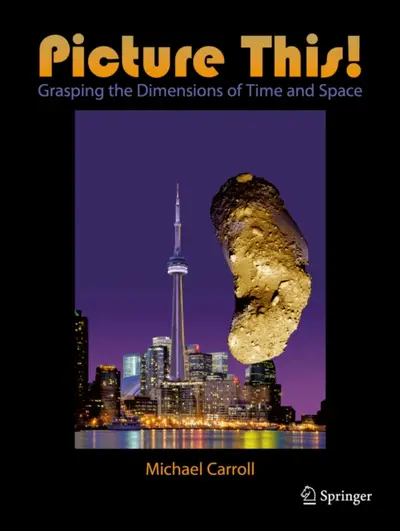
Astronomical concepts can be truly hard to comprehend, especially those of planetary sizes and distances from Earth and from each other. These concepts are made more comprehensible by the group of illustrations in this book, which put scale extraterrestrial objects side by side with objects on Earth we can more easily relate to. For example, study the pictures of Earth floating above Jupiter's Great Red Spot and the asteroid Itokawa resting beside Toronto's CN Tower. These mind-bending images bring things better into perspective and will help you understand the size and scale of our Solar System. In later chapters, you will be told how close the visionaries of the past came to guessing what today's explorers would find. Astronomer/painter Lucien Rudaux's masterpieces of Mars dust storms anticipated Viking and Mars rover images by nearly a century. Space artist Ludek Pesek envisioned astronauts setting up camp on the lunar surface in scenes hauntingly similar to photos taken by Apollo astronauts decades later. But the real benefit of this work is in better grasping the nature of our universe -- how big it is, now large it is, and how we fit into it.
Bibliographic data © Gardners Books Ltd.