EPUB · English
Troy on Display
Scepticism and Wonder at Schliemann''s First Exhibition
Price and availability
$40.99
Available in: Andorra, Austria, Australia, Belgium, Bulgaria, Canada, Switzerland, Cyprus, Czechia, Germany, Denmark, Estonia, Spain, Finland, France, United Kingdom, Guernsey, Greece, Croatia, Hungary, Ireland, Isle of Man, Iceland, Italy, Jersey, Japan, Liechtenstein, Lithuania, Luxembourg, Latvia, Monaco, Malta, Netherlands, Norway, Poland, Portugal, Romania, Sweden, Slovenia, Slovakia, San Marino, United States, Vatican City, South Africa
Stores: US, UK, Canada, EU, Australia.
Sign in to buyThe price is re-checked by the server before payment.
For personal use under the eBook licence.
- Format
- EPUB
- DRM
- Not stated by the publisher
- Language
- English
- Publisher
- Bloomsbury Publishing
- Published
- 3 October 2019
- Pages
- 280
- ISBN
- 9781350114302
- Subjects
- London, Greater London, Ancient Greece, c 1800 to c 1900, History of art: ancient & classical art,BCE to c 500 CE, Exhibition catalogues & specific collections, Social & cultural history, Archaeology, 1QBAG, 3MN, AGA, Exhibition catalogues and specific collections, NHTB, NK
About this book
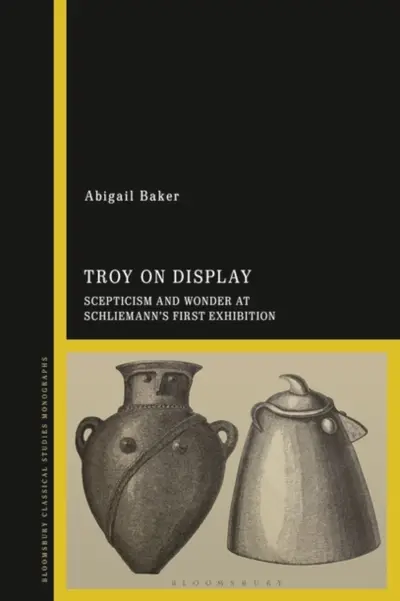
This book explores what visitors saw at the Trojan exhibition and why its contents, including treasure, plain pottery and human remains captured imaginations and divided opinions. When Schliemann's Trojan collection was first exhibited in 1877, no-one had seen anything like it. Schliemann claimed these objects had been owned by participants in the Trojan War and that they were tangible evidence that Homer's epics were true. Yet, these objects did not reflect the heroic past imagined by Victorians, and a fierce controversy broke out about the collection's value and significance.Schliemann invited Londoners to see the very unclassical objects on display as the roots of classical culture. Artists, poets, historians, race theorists, bankers and humourists took up this challenge, but their conclusions were not always to Schliemann's liking. Troy's appeal lay in its materiality: visitors could apply analytical techniques (from aesthetic appreciation to skull-measuring) to the collection and draw their own conclusions. This book argues for a deep examination of museum exhibitions as a constructed spatial experience, which can transform how the past is seen. This new angle on a famous archaeological discovery shows the museum as a site of controversy, where hard evidence and wild imagination came together to form a lasting image of Troy.
Bibliographic data © Gardners Books Ltd.