PDF · English
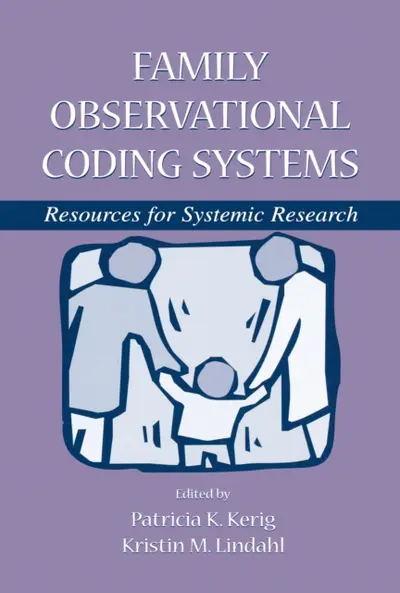
Family Observational Coding Systems
Resources for Systemic Research
Price and availability
$79.99
Available in: Andorra, Austria, Australia, Belgium, Bulgaria, Canada, Switzerland, Cyprus, Czechia, Germany, Denmark, Estonia, Spain, Finland, France, United Kingdom, Guernsey, Greece, Croatia, Hungary, Ireland, Isle of Man, Iceland, Italy, Jersey, Japan, Liechtenstein, Lithuania, Luxembourg, Latvia, Monaco, Malta, Netherlands, Norway, Poland, Portugal, Romania, Sweden, Slovenia, Slovakia, San Marino, United States, Vatican City, South Africa
Stores: US, UK, Canada, EU, Australia.
Sign in to buyThe price is re-checked by the server before payment.
For personal use under the eBook licence.
- Format
- DRM
- Not stated by the publisher
- Language
- English
- Publisher
- Taylor & Francis
- Published
- 1 August 2000
- ISBN
- 9781135667610
- Subjects
- Sociology: family & relationships, Psychology, Psychological methodology, Psychology of ageing, Family psychology, Social, group or collective psychology, Psychotherapy, Research methods / methodology, Sociology: family, kinship and relationships
About this book
CODING MANUAL INFORMATION IS AVAILABLE FROM THE CHAPTER AUTHORS, AND THEIR E-MAIL ADDRESSES CAN BE FOUND ON PAGE XV OF THE BOOK.Family studies is an area that has enjoyed the benefits of conceptual and methodological advances in recent years including the widespread adoption of observational research techniques. The selection of an appropriate coding system is critical to achieving a better understanding of the complex family processes related to normative and pathological development. This book presents 14 examples of family observational coding systems, chosen for the wide range of constructs and phenomena they capture. Each system is described in detail, and excerpts from the coding manual are presented (links to the full coding manuals are available to purchasers of the book at LEA's Web site, www.erlbaum.com). Each chapter follows a consistent outline, so that the different coding systems can be more easily compared to one another. They include the theoretical underpinnings of the measure, its reliability and validity, the coding process, strategies for coder training, and examples of studies in which it has been used. This volume will prove invaluable to students and researchers in family studies, clinicians, and other practitioners who need to interpret data from family observations.
Bibliographic data © Gardners Books Ltd.