PDF · English
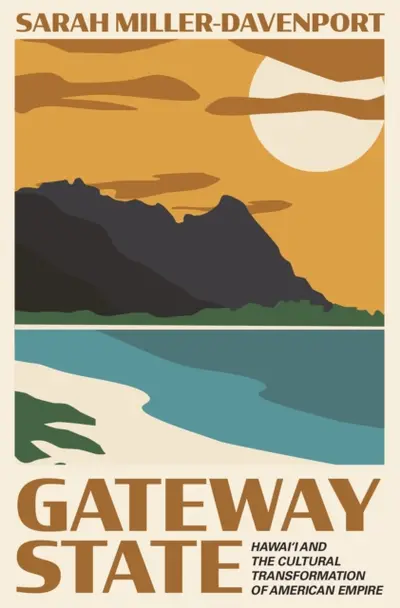
Gateway State
Hawai‘i and the Cultural Transformation of American Empire
Price and availability
$37.99
Available in: Andorra, Austria, Australia, Belgium, Bulgaria, Canada, Switzerland, Cyprus, Czechia, Germany, Denmark, Estonia, Spain, Finland, France, United Kingdom, Guernsey, Greece, Croatia, Hungary, Ireland, Isle of Man, Iceland, Italy, Jersey, Japan, Liechtenstein, Lithuania, Luxembourg, Latvia, Monaco, Malta, Netherlands, Norway, Poland, Portugal, Romania, Sweden, Slovenia, Slovakia, San Marino, United States, Vatican City, South Africa
Stores: US, UK, Canada, EU, Australia.
Sign in to buyThe price is re-checked by the server before payment.
For personal use under the eBook licence.
- Format
- DRM
- Not stated by the publisher
- Language
- English
- Publisher
- Princeton University Press
- Published
- 9 April 2019
- ISBN
- 9780691185965
- Subjects
- USA, Western & Pacific Coast states, Hawaii, 20th century, History of the Americas, Political science & theory, Constitution: government & the state, Political structures: democracy, Central government policies, United States of America, USA, US West, Politics and government, Political science and theory, Political structures / systems: democracy, Central / national / federal government policies, History of the Americas, Local history
About this book
How Hawai'i became an emblem of multiculturalism during its journey to statehood in the mid-twentieth centuryGateway State explores the development of Hawai'i as a model for liberal multiculturalism and a tool of American global power in the era of decolonization. The establishment of Hawai'i statehood in 1959 was a watershed moment, not only in the ways Americans defined their nation's role on the international stage but also in the ways they understood the problems of social difference at home. Hawai'i's remarkable transition from territory to state heralded the emergence of postwar multiculturalism, which was a response both to independence movements abroad and to the limits of civil rights in the United States.Once a racially problematic overseas colony, by the 1960s, Hawai'i had come to symbolize John F. Kennedy's New Frontier. This was a more inclusive idea of who counted as American at home and what areas of the world were considered to be within the U.S. sphere of influence. Statehood advocates argued that Hawai'i and its majority Asian population could serve as a bridge to Cold War Asia-and as a global showcase of American democracy and racial harmony. In the aftermath of statehood, business leaders and policymakers worked to institutionalize and sell this ideal by capitalizing on Hawai'i's diversity. Asian Americans in Hawai'i never lost a perceived connection to Asia. Instead, their ethnic difference became a marketable resource to help other Americans navigate a decolonizing world.As excitement over statehood dimmed, the utopian vision of Hawai'i fell apart, revealing how racial inequality and U.S. imperialism continued to shape the fiftieth state-and igniting a backlash against the islands' white-dominated institutions.
Bibliographic data © Gardners Books Ltd.