EPUB · English
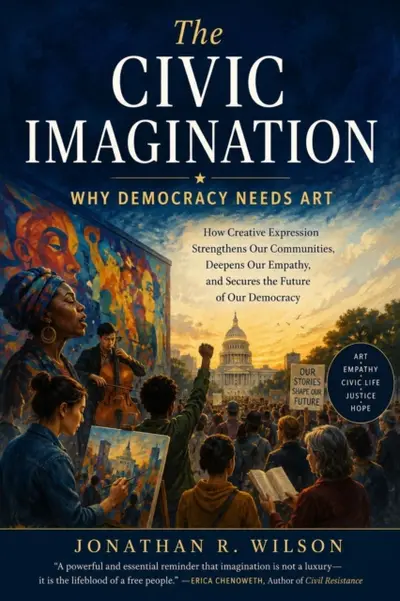
Civic Imagination
Why Democracy Needs Art
Price and availability
$3.99
Available in: Andorra, Austria, Australia, Belgium, Bulgaria, Canada, Switzerland, Cyprus, Czechia, Germany, Denmark, Estonia, Spain, Finland, France, United Kingdom, Guernsey, Greece, Croatia, Hungary, Ireland, Isle of Man, Iceland, Italy, Jersey, Japan, Liechtenstein, Lithuania, Luxembourg, Latvia, Monaco, Malta, Netherlands, Norway, Poland, Portugal, Romania, Sweden, Slovenia, Slovakia, San Marino, United States, Vatican City, South Africa
Stores: US, UK, Canada, EU, Australia.
Sign in to buyThe price is re-checked by the server before payment.
For personal use under the eBook licence.
- Format
- EPUB
- DRM
- Not stated by the publisher
- Language
- English
- Publisher
- eBookIt.com
- Published
- 9 June 2026
- ISBN
- 9781456683467
- Subjects
- The arts: general issues, Sociology, Elections & referenda, The arts: general topics, Sociology, Elections and referenda / suffrage
About this book
The Civic Imagination: Why Democracy Needs Art makes a powerful case that democracy depends on more than elections, laws, and institutions. It also requires the human capacities that art helps cultivate: empathy, imagination, critical thinking, and the ability to recognize the dignity of others. Drawing on history, political science, education, psychology, and cultural studies, Jonathan R. Wilson shows how music, literature, theater, visual art, dance, architecture, and storytelling have long shaped civic life and democratic change. From protest songs and murals to museums and community theater, art has helped preserve memory, challenge injustice, and widen public dialogue. The book explores how artistic expression has supported abolition, labor reform, women's suffrage, civil rights, and contemporary social movements, while also explaining why authoritarian regimes so often censor artists and fear creative freedom. At a time when arts education and public investment in culture are under pressure, this book argues that art is not a luxury. It is democratic infrastructure, essential to a society that hopes to remain open, pluralistic, and resilient.
Bibliographic data © Gardners Books Ltd.