PDF · English
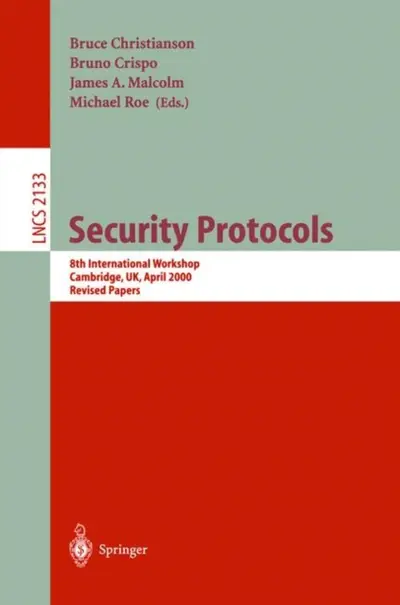
Security Protocols
8th International Workshops Cambridge, UK, April 3-5, 2000 Revised Papers
Price and availability
$60.99
Available in: Andorra, Austria, Australia, Belgium, Bulgaria, Canada, Switzerland, Cyprus, Czechia, Germany, Denmark, Estonia, Spain, Finland, France, United Kingdom, Guernsey, Greece, Croatia, Hungary, Ireland, Isle of Man, Iceland, Italy, Jersey, Japan, Liechtenstein, Lithuania, Luxembourg, Latvia, Monaco, Malta, Netherlands, Norway, Poland, Portugal, Romania, Sweden, Slovenia, Slovakia, San Marino, United States, Vatican City, South Africa
Stores: US, UK, Canada, EU, Australia.
Sign in to buyThe price is re-checked by the server before payment.
For personal use under the eBook licence.
- Format
- DRM
- Not stated by the publisher
- Language
- English
- Publisher
- Springer Berlin Heidelberg
- Published
- 30 June 2003
- ISBN
- 9783540448105
- Subjects
- Coding theory & cryptology, Knowledge management, Business applications, Algorithms & data structures, Computer security, Privacy & data protection, Data encryption, Computer networking & communications, Coding theory and cryptology, Business mathematics and systems, Business applications, Network hardware, Algorithms and data structures, Computer security, Data encryption, Network security
About this book
The Cambridge International Workshop on Security Protocols has now run for eight years. Each year we set a theme, focusing upon a speci?c aspect of security protocols, and invite position papers. Anybody is welcome to send us a position paper (yes, you are invited) and we don't insist they relate to the current theme in an obvious way. In our experience, the emergence of the theme as a unifying threadtakesplaceduringthediscussionsattheworkshopitself.Theonlyground rule is that position papers should formulate an approach to some unresolved issues, rather than being a description of a ?nished piece of work. Whentheparticipantsmeet,wetrytofocusthediscussionsupontheconc- tual issues which emerge. Security protocols link naturally to many other areas of Computer Science, and deep water can be reached very quickly. Afterwards, we invite participants to re-draft their position papers in a way which exposes the emergent issues but leaves open the way to their further development. We also prepare written transcripts of the recorded discussions. These are edited (in some cases very heavily) to illustrate the way in which the di?erent arguments and perspectives have interacted. We publish these proceedings as an invitation to the research community. Although many interesting results ?rst see the light of day in a volume of our proceedings, laying claim to these is not our primary purpose of publication. Rather, we bring our discussions and insights to a wider audience in order to suggest new lines of investigation which the community may fruitfully pursue.
Bibliographic data © Gardners Books Ltd.