PDF · English
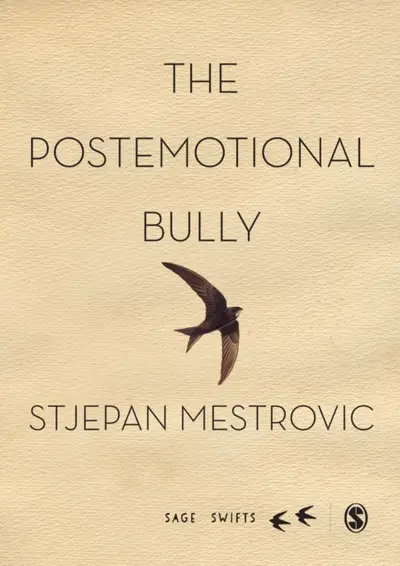
Postemotional Bully
Price and availability
$70.99
Available in: Andorra, Austria, Australia, Belgium, Bulgaria, Canada, Switzerland, Cyprus, Czechia, Germany, Denmark, Estonia, Spain, Finland, France, United Kingdom, Guernsey, Greece, Croatia, Hungary, Ireland, Isle of Man, Iceland, Italy, Jersey, Japan, Liechtenstein, Lithuania, Luxembourg, Latvia, Monaco, Malta, Netherlands, Norway, Poland, Portugal, Romania, Sweden, Slovenia, Slovakia, San Marino, United States, Vatican City, South Africa
Stores: US, UK, Canada, EU, Australia.
Sign in to buyThe price is re-checked by the server before payment.
For personal use under the eBook licence.
- Format
- DRM
- Not stated by the publisher
- Language
- English
- Publisher
- SAGE Publications
- Published
- 15 December 2014
- Pages
- 136
- ISBN
- 9781473910973
- Subjects
- Social interaction, Social theory, Crime & criminology, Social, group or collective psychology, Politics & government, Sociology
About this book
The topics of bullying and hazing have sparked interest and discussion in recent years. Hazing is a crime in the United States, and Western nations have made efforts to stamp out bullying in schools, the workplace, and institutions. However, for the most part, bullying and hazing are ill-defined and lack theoretical perspective. Mestrovic brings classical as well as contemporary social theory to bear on this discussion. Thorstein Veblen defined the predatory barbarian as the social type, enshrined by modernity, who prefers to use force over peacable means to achieve ends. On the other extreme, Marcel Mauss wrote about the spirit of the gift and its obligations - to give, to receive, and to reciprocate - as the fundamental basis of social life. Yet, he argued that the spirit of modernity was disappearing with the progress of modernity. Mestrovic traces this fundamental opposition between barbaric force or bullying versus benign obligation that is the spirit of the gift through a host of modernist and postmodernist thinkers and theories. He introduces the concept of the 'postemotional bully' as an alternative to both of these major bodies of social theory. The postemotional bully, as a social type, is fungible, beset by screen-images on media and social media that are isolating, and is at the mercy of the peer-group. Case studies focus on bullying and hazing, specifically the cases of an American solider who committed suicide in Afghanistan, instances of torture at Abu Ghraib, and the murder of a 23-year-old African-American inmate in a Southern state prison in the US.
Bibliographic data © Gardners Books Ltd.