EPUB · English
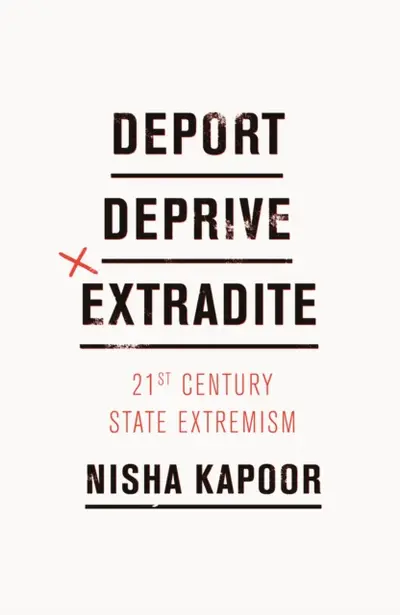
Deport, Deprive, Extradite
Twenty-First-Century State Extremism
Price and availability
Not sold in this region
Available in: Andorra, Austria, Australia, Belgium, Bulgaria, Switzerland, Cyprus, Czechia, Germany, Denmark, Estonia, Spain, Finland, France, United Kingdom, Guernsey, Greece, Croatia, Hungary, Ireland, Isle of Man, Iceland, Italy, Jersey, Japan, Liechtenstein, Lithuania, Luxembourg, Latvia, Monaco, Malta, Netherlands, Norway, Poland, Portugal, Romania, Sweden, Slovenia, Slovakia, San Marino, Vatican City, South Africa
Stores: UK, EU, Australia. Not available in the United States store.
This title cannot be bought in this store yet: its supplier terms, territorial rights or price are still being confirmed.
For personal use under the eBook licence.
- Format
- EPUB
- DRM
- Not stated by the publisher
- Language
- English
- Publisher
- Verso
- Published
- 27 March 2018
- ISBN
- 9781786633491
- Subjects
- Refugees & political asylum, Migration, immigration & emigration, Police & security services, Civil rights & citizenship, Political oppression & persecution, Terrorism law, Police and security services, Political oppression and persecution, Criminal law: terrorism law
About this book
When Minh Pham was extradited from Britain to the US to face terrorism related charges, his appeal against the deprivation of his British citizenship was still pending. Soon after he arrived his appeal was lost and he was effectively made stateless. Pham's story is one of the many in Deport, Deprive, Extradite, illustrating the perpetual enhancement of state power and its capabilities to expel.In looking at these stories of Muslim men accused of terrorism-related offences, Nisha Kapoor exposes how these racialised subjects are dehumanized, made non-human, both in terms of how they are represented and via the disciplinary techniques used to expel them. She explores how the establishment of these non-humans enables the expansion of inhumanity more broadly, targeting Muslims, people of colour, immigrants and refugees. In asking what such cases illuminate and legitimate about precariousness and dispossession, she offers a radical analysis of the contemporary security state.
Bibliographic data © Gardners Books Ltd.