PDF · English
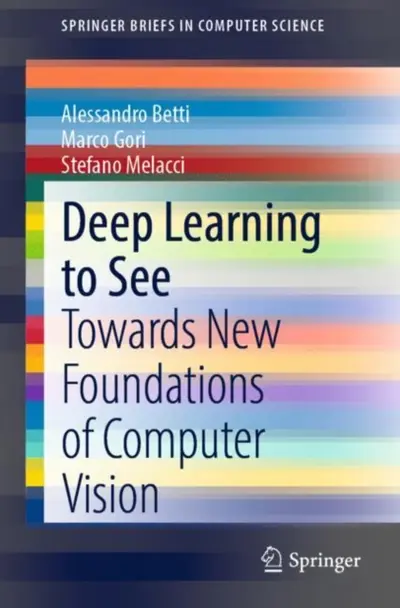
Deep Learning to See
Towards New Foundations of Computer Vision
Price and availability
$74.99
Available in: Andorra, Austria, Australia, Belgium, Bulgaria, Canada, Switzerland, Cyprus, Czechia, Germany, Denmark, Estonia, Spain, Finland, France, United Kingdom, Guernsey, Greece, Croatia, Hungary, Ireland, Isle of Man, Iceland, Italy, Jersey, Japan, Liechtenstein, Lithuania, Luxembourg, Latvia, Monaco, Malta, Netherlands, Norway, Poland, Portugal, Romania, Sweden, Slovenia, Slovakia, San Marino, United States, Vatican City, South Africa
Stores: US, UK, Canada, EU, Australia.
Sign in to buyThe price is re-checked by the server before payment.
For personal use under the eBook licence.
- Format
- DRM
- Not stated by the publisher
- Language
- English
- Publisher
- Springer International Publishing
- Published
- 26 April 2022
- ISBN
- 9783030909871
- Subjects
- Optical physics, Neurosciences, Machine learning, Computer vision, Image processing, Optical physics, Neurosciences, Machine learning, Computer vision
About this book
The remarkable progress in computer vision over the last few years is, by and large, attributed to deep learning, fueled by the availability of huge sets of labeled data, and paired with the explosive growth of the GPU paradigm. While subscribing to this view, this work criticizes the supposed scientific progress in the field, and proposes the investigation of vision within the framework of information-based laws of nature.This work poses fundamental questions about vision that remain far from understood, leading the reader on a journey populated by novel challenges resonating with the foundations of machine learning. The central thesis proposed is that for a deeper understanding of visual computational processes, it is necessary to look beyond the applications of general purpose machine learning algorithms, and focus instead on appropriate learning theories that take into account the spatiotemporal nature of the visual signal.Serving to inspire and stimulate critical reflection and discussion, yet requiring no prior advanced technical knowledge, the text can naturally be paired with classic textbooks on computer vision to better frame the current state of the art, open problems, and novel potential solutions. As such, it will be of great benefit to graduate and advanced undergraduate students in computer science, computational neuroscience, physics, and other related disciplines.
Bibliographic data © Gardners Books Ltd.