PDF · English
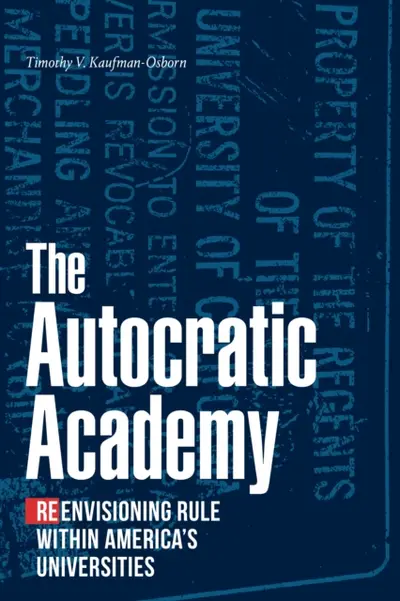
Autocratic Academy
Reenvisioning Rule within America''s Universities
Price and availability
$39.99
Available in: Andorra, Austria, Australia, Belgium, Bulgaria, Canada, Switzerland, Cyprus, Czechia, Germany, Denmark, Estonia, Spain, Finland, France, United Kingdom, Guernsey, Greece, Croatia, Hungary, Ireland, Isle of Man, Iceland, Italy, Jersey, Japan, Liechtenstein, Lithuania, Luxembourg, Latvia, Monaco, Malta, Netherlands, Norway, Poland, Portugal, Romania, Sweden, Slovenia, Slovakia, San Marino, United States, Vatican City, South Africa
Stores: US, UK, Canada, EU, Australia.
Sign in to buyThe price is re-checked by the server before payment.
For personal use under the eBook licence.
- Format
- DRM
- Not stated by the publisher
- Language
- English
- Publisher
- Duke University Press
- Published
- 6 March 2023
- ISBN
- 9781478024392
- Subjects
- Educational strategies & policy, Higher & further education, tertiary education, Educational strategies and policy, Higher education, tertiary education
About this book
Critics of contemporary US higher education often point to the academy's "e;corporatization"e; as one of its defining maladies. However, in The Autocratic Academy Timothy V. Kaufman-Osborn argues that American colleges and universities have always been organized as corporations in which the power to rule is legally vested in and monopolized by antidemocratic governing boards. This institutional form, Kaufman-Osborn contends, is antithetical to the free inquiry that defines the purpose of higher education. Tracing the history of the American academy from the founding of Harvard (1636), through the Supreme Court's Dartmouth v. Woodward ruling (1819), and into the twenty-first century, Kaufman-Osborn shows how the university's autocratic legal constitution is now yoked to its representation on the model of private property. Explaining why appeals to the cause of shared governance cannot succeed in wresting power from the academy's autocrats, Kaufman-Osborn argues that American universities must now be reincorporated in accordance with the principles of democratic republicanism. Only then can the academy's members hold accountable those chosen to govern and collectively determine the disposition of higher education's unique public goods.
Bibliographic data © Gardners Books Ltd.