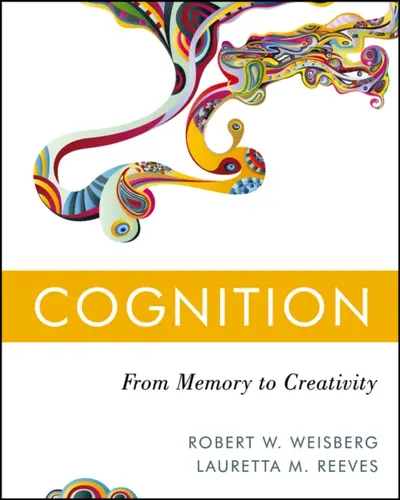
PDF · English
Cognition
From Memory to Creativity
Price and availability
$160.99
Available in: Andorra, Austria, Australia, Belgium, Bulgaria, Canada, Switzerland, Cyprus, Czechia, Germany, Denmark, Estonia, Spain, Finland, France, United Kingdom, Guernsey, Greece, Croatia, Hungary, Ireland, Isle of Man, Iceland, Italy, Jersey, Japan, Liechtenstein, Lithuania, Luxembourg, Latvia, Monaco, Malta, Netherlands, Norway, Poland, Portugal, Romania, Sweden, Slovenia, Slovakia, San Marino, United States, Vatican City, South Africa
Stores: US, UK, Canada, EU, Australia.
Sign in to buyThe price is re-checked by the server before payment.
For personal use under the eBook licence.
- Format
- DRM
- Not stated by the publisher
- Language
- English
- Publisher
- Wiley
- Published
- 30 January 2013
- ISBN
- 9781118220108
- Subjects
- Psychology, Cognition & cognitive psychology, Psychology, Cognition and cognitive psychology
About this book
From memory to creativity a complete and current presentation of the field of cognition The process of cognition allows us to function in life; it translates inputs from the world so we can recognize the sound of the alarm clock, remember the day of the week, and decide which clothes to wear. Cognition: From Memory to Creativity provides readers with a clear, research-based, and well-illustrated presentation of the field, starting with memory the most accessible starting point to more complex functions and research in information processing. Authors Robert Weisberg and Lauretta Reeves include the newest neurological findings that help us understand the human processes that allow for cognition. Unique in its organization, Cognition incorporates both classical and modern research and provides demonstration experiments for students to conduct with simple materials. Cognition explores: Models of memory and memory systems Encoding and retrieval Forgetting vs. false memory Visual cognition Attention and imagery Sounds, words, and meaning Logical thinking and decision making Problem solving and creative thinking
Bibliographic data © Gardners Books Ltd.