PDF · English
Constitutional Personae
Heroes, Soldiers, Minimalists, and Mutes
Price and availability
$18.99
Available in: Andorra, Austria, Australia, Belgium, Bulgaria, Canada, Switzerland, Cyprus, Czechia, Germany, Denmark, Estonia, Spain, Finland, France, United Kingdom, Guernsey, Greece, Croatia, Hungary, Ireland, Isle of Man, Iceland, Italy, Jersey, Japan, Liechtenstein, Lithuania, Luxembourg, Latvia, Monaco, Malta, Netherlands, Norway, Poland, Portugal, Romania, Sweden, Slovenia, Slovakia, San Marino, United States, Vatican City, South Africa
Stores: US, UK, Canada, EU, Australia.
Sign in to buyThe price is re-checked by the server before payment.
For personal use under the eBook licence.
- Format
- DRM
- Not stated by the publisher
- Language
- English
- Publisher
- Oxford University Press
- Published
- 7 September 2015
- ISBN
- 9780190222680
- Subjects
- USA, Legal history, Courts & procedure, Constitutional & administrative law, United States of America, USA, Legal history, Legal systems: courts and procedures, Constitutional and administrative law: general
About this book
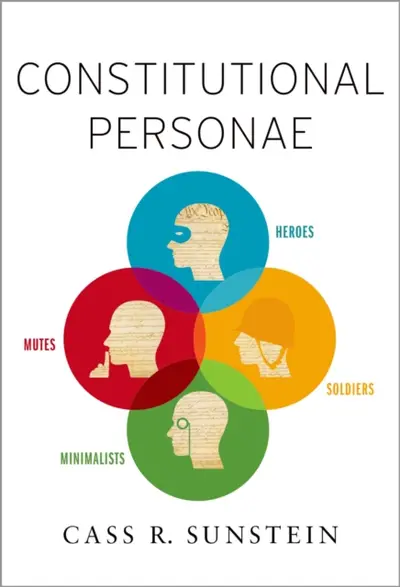
Since America's founding, the U.S. Supreme Court had issued a vast number of decisions on a staggeringly wide variety of subjects. And hundreds of judges have occupied the bench. Yet as Cass R. Sunstein, the eminent legal scholar and bestselling co-author of Nudge, points out, almost every one of the Justices fits into a very small number of types regardless of ideology: the hero, the soldier, the minimalist, and the mute. Heroes are willing to invoke the Constitution to invalidate state laws, federal legislation, and prior Court decisions. They loudly embrace first principles and are prone to flair, employing dramatic language to fundamentally reshape the law. Soldiers, on the other hand, are skeptical of judicial power, and typically defer to decisions made by the political branches. Minimalists favor small steps and only incremental change. They worry that bold reversals of long-established traditions may be counterproductive, producing a backlash that only leads to another reversal. Mutes would rather say nothing at all about the big constitutional issues, and instead tend to decide cases on narrow grounds or keep controversial cases out of the Court altogether by denying standing. As Sunstein shows, many of the most important constitutional debates are in fact contests between the four Personae. Whether the issue involves slavery, gender equality, same-sex marriage, executive power, surveillance, or freedom of speech, debates have turned on choices made among the four Personae--choices that derive as much from psychology as constitutional theory. Sunstein himself defends a form of minimalism, arguing that it is the best approach in a self-governing society of free people. More broadly, he casts a genuinely novel light on longstanding disputes over the proper way to interpret the constitution, demonstrating that behind virtually every decision and beneath all of the abstract theory lurk the four Personae. By emphasizing the centrality of character types, Sunstein forces us to rethink everything we know about how the Supreme Court works.
Bibliographic data © Gardners Books Ltd.