PDF · English
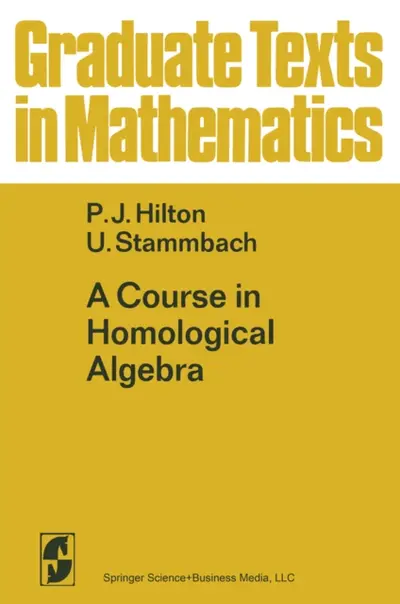
Course in Homological Algebra
Price and availability
$97.99
Available in: Andorra, Austria, Australia, Belgium, Bulgaria, Canada, Switzerland, Cyprus, Czechia, Germany, Denmark, Estonia, Spain, Finland, France, United Kingdom, Guernsey, Greece, Croatia, Hungary, Ireland, Isle of Man, Iceland, Italy, Jersey, Japan, Liechtenstein, Lithuania, Luxembourg, Latvia, Monaco, Malta, Netherlands, Norway, Poland, Portugal, Romania, Sweden, Slovenia, Slovakia, San Marino, United States, Vatican City, South Africa
Stores: US, UK, Canada, EU, Australia.
Sign in to buyThe price is re-checked by the server before payment.
For personal use under the eBook licence.
- Format
- DRM
- Not stated by the publisher
- Language
- English
- Publisher
- Springer New York
- Published
- 9 March 2013
- ISBN
- 9781468499360
- Subjects
- Mathematics, Algebra, Mathematics, Algebra
About this book
In this chapter we are largely influenced in our choice of material by the demands of the rest of the book. However, we take the view that this is an opportunity for the student to grasp basic categorical notions which permeate so much of mathematics today, including, of course, algebraic topology, so that we do not allow ourselves to be rigidly restricted by our immediate objectives. A reader totally unfamiliar with category theory may find it easiest to restrict his first reading of Chapter II to Sections 1 to 6; large parts of the book are understandable with the material presented in these sections. Another reader, who had already met many examples of categorical formulations and concepts might, in fact, prefer to look at Chapter II before reading Chapter I. Of course the reader thoroughly familiar with category theory could, in principal, omit Chapter II, except perhaps to familiarize himself with the notations employed. In Chapter III we begin the proper study of homological algebra by looking in particular at the group ExtA(A, B), where A and Bare A-modules. It is shown how this group can be calculated by means of a projective presentation of A, or an injective presentation of B; and how it may also be identified with the group of equivalence classes of extensions of the quotient module A by the submodule B.
Bibliographic data © Gardners Books Ltd.