EPUB · English
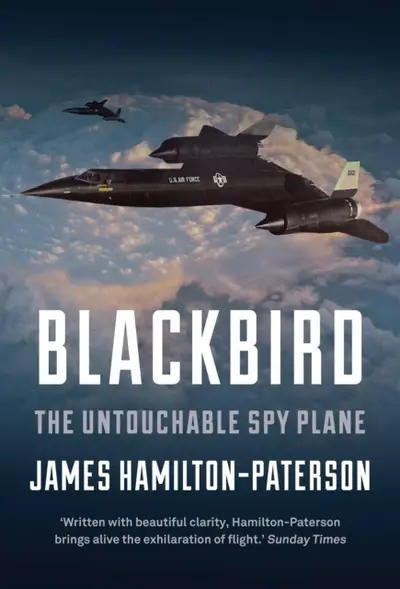
Blackbird
The Story of the Lockheed SR-71 Spy Plane
Price and availability
Not sold in this region
Available in: Andorra, Austria, Australia, Belgium, Bulgaria, Switzerland, Cyprus, Czechia, Germany, Denmark, Estonia, Spain, Finland, France, United Kingdom, Guernsey, Greece, Croatia, Hungary, Ireland, Isle of Man, Iceland, Italy, Jersey, Japan, Liechtenstein, Lithuania, Luxembourg, Latvia, Monaco, Malta, Netherlands, Norway, Poland, Portugal, Romania, Sweden, Slovenia, Slovakia, San Marino, Vatican City, South Africa
Stores: UK, EU, Australia. Not available in the United States store.
This title cannot be bought in this store yet: its supplier terms, territorial rights or price are still being confirmed.
For personal use under the eBook licence.
- Format
- EPUB
- DRM
- Not stated by the publisher
- Language
- English
- Publisher
- Bloomsbury Publishing
- Published
- 1 June 2017
- Pages
- 192
- ISBN
- 9781786691194
- Subjects
- USA, Air forces & warfare, Military vehicles, Military aircraft, History of engineering & technology, Aerospace & aviation technology, United States of America, USA, JWCM, Military vehicles and transport of air, land and sea, History of engineering and technology, Aerospace and aviation technology
About this book
The American 'spy' aircraft, the SR-71 'Blackbird' was deliberately designed to be the world's fastest and highest-flying aircraft and has never been approached since. It was conceived in the late 1950s by Lockheed Martin's highly secret 'Skunk Works' team under one of the most (possibly the most) brilliant aero designers of all time, Clarence 'Kelly' Johnson. Once fully developed in around 1963/4 the Blackbird represented the apogee of jet-powered flight. It could fly at well over three times the speed of sound above 85,000 feet and had an unrefuelled range of 3,200 nautical miles. It flew with great success until 1998 (with NASA 1999). Despite extensive use over Vietnam and later battlefields none was ever shot down (unlike the U2 in the Gary Powers incident). The Blackbird's capabilities seem unlikely ever to be exceeded. It was retired because its job could be done by satellites, and in today's steady trend towards unmanned military aircraft it is improbable that anyone will ever again need to design a jet aircraft capable of such speed.
Bibliographic data © Gardners Books Ltd.