PDF · English
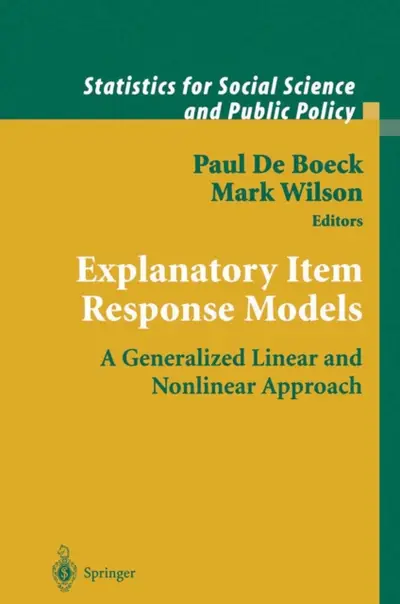
Explanatory Item Response Models
A Generalized Linear and Nonlinear Approach
Price and availability
$242.99
Available in: Andorra, Austria, Australia, Belgium, Bulgaria, Canada, Switzerland, Cyprus, Czechia, Germany, Denmark, Estonia, Spain, Finland, France, United Kingdom, Guernsey, Greece, Croatia, Hungary, Ireland, Isle of Man, Iceland, Italy, Jersey, Japan, Liechtenstein, Lithuania, Luxembourg, Latvia, Monaco, Malta, Netherlands, Norway, Poland, Portugal, Romania, Sweden, Slovenia, Slovakia, San Marino, United States, Vatican City, South Africa
Stores: US, UK, Canada, EU, Australia.
Sign in to buyThe price is re-checked by the server before payment.
For personal use under the eBook licence.
- Format
- DRM
- Not stated by the publisher
- Language
- English
- Publisher
- Springer New York
- Published
- 9 March 2013
- ISBN
- 9781475739909
- Subjects
- Social research & statistics, Psychological testing & measurement, Examinations & assessment, Probability & statistics, Social research and statistics, Psychological testing and measurement, Education: examinations and assessment
About this book
This edited volume gives a new and integrated introduction to item re- sponse models (predominantly used in measurement applications in psy- chology, education, and other social science areas) from the viewpoint of the statistical theory of generalized linear and nonlinear mixed models. Moreover, this new framework aHows the domain of item response mod- els to be co-ordinated and broadened to emphasize their explanatory uses beyond their standard descriptive uses. The basic explanatory principle is that item responses can be modeled as a function of predictors of various kinds. The predictors can be (a) char- acteristics of items, of persons, and of combinations of persons and items; they can be (b) observed or latent (of either items or persons); and they can be (c) latent continuous or latent categorical. Thus, a broad range of models can be generated, including a wide range of extant item response models as weH as some new ones. Within this range, models with explana- tory predictors are given special attention, but we also discuss descriptive models. Note that the 'item responses' that we are referring to are not just the traditional 'test data,' but are broadly conceived as categorical data from a repeated observations design. Hence, data from studies with repeated-observations experimental designs, or with longitudinal designs, mayaIso be modeled. The intended audience for this volume is rather broad.
Bibliographic data © Gardners Books Ltd.