PDF · English
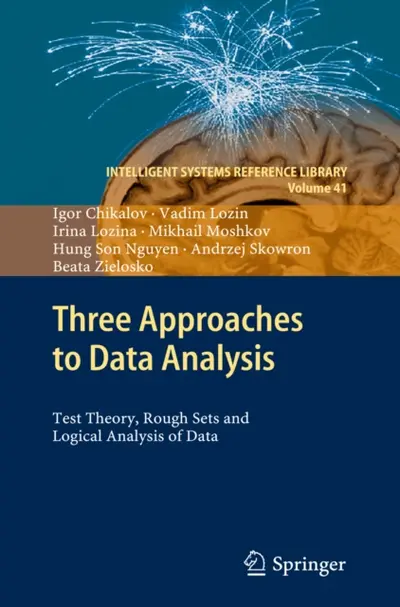
Three Approaches to Data Analysis
Test Theory, Rough Sets and Logical Analysis of Data
Price and availability
$120.99
Available in: Andorra, Austria, Australia, Belgium, Bulgaria, Canada, Switzerland, Cyprus, Czechia, Germany, Denmark, Estonia, Spain, Finland, France, United Kingdom, Guernsey, Greece, Croatia, Hungary, Ireland, Isle of Man, Iceland, Italy, Jersey, Japan, Liechtenstein, Lithuania, Luxembourg, Latvia, Monaco, Malta, Netherlands, Norway, Poland, Portugal, Romania, Sweden, Slovenia, Slovakia, San Marino, United States, Vatican City, South Africa
Stores: US, UK, Canada, EU, Australia.
Sign in to buyThe price is re-checked by the server before payment.
For personal use under the eBook licence.
- Format
- DRM
- Not stated by the publisher
- Language
- English
- Publisher
- Springer Berlin Heidelberg
- Published
- 28 July 2012
- ISBN
- 9783642286674
- Subjects
- Engineering: general, Algorithms & data structures, Artificial intelligence, Artificial intelligence (AI)
About this book
In this book, the following three approaches to data analysis are presented: - Test Theory, founded by Sergei V. Yablonskii (1924-1998); the first publications appeared in 1955 and 1958,- Rough Sets, founded by Zdzislaw I. Pawlak (1926-2006); the first publications appeared in 1981 and 1982,- Logical Analysis of Data, founded by Peter L. Hammer (1936-2006); the first publications appeared in 1986 and 1988.These three approaches have much in common, but researchers active in one of these areas often have a limited knowledge about the results and methods developed in the other two. On the other hand, each of the approaches shows some originality and we believe that the exchange of knowledge can stimulate further development of each of them. This can lead to new theoretical results and real-life applications and, in particular, new results based on combination of these three data analysis approaches can be expected.- Logical Analysis of Data, founded by Peter L. Hammer (1936-2006); the firstpublications appeared in 1986 and 1988.These three approaches have much in common, but researchers active in one of these areas often have a limited knowledge about the results and methods developed in the other two. On the other hand, each of the approaches shows some originality and we believe that the exchange of knowledge can stimulate further development of each of them. This can lead to new theoretical results and real-life applications and, in particular, new results based on combination of these three data analysis approaches can be expected.These three approaches have much in common, but researchers active in one of these areas often have a limited knowledge about the results and methods developed in the other two. On the other hand, each of the approaches shows some originality and we believe that the exchange of knowledge can stimulate further development of each of them. This can lead to new theoretical results and real-life applications and, in particular, new results based on combination of these three data analysis approaches can be expected.
Bibliographic data © Gardners Books Ltd.