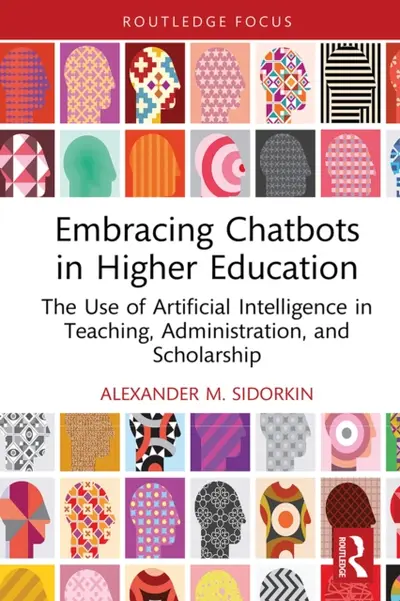
PDF · English
Embracing Chatbots in Higher Education
The Use of Artificial Intelligence in Teaching, Administration, and Scholarship
Price and availability
$29.99
Available in: Andorra, Austria, Australia, Belgium, Bulgaria, Canada, Switzerland, Cyprus, Czechia, Germany, Denmark, Estonia, Spain, Finland, France, United Kingdom, Guernsey, Greece, Croatia, Hungary, Ireland, Isle of Man, Iceland, Italy, Jersey, Japan, Liechtenstein, Lithuania, Luxembourg, Latvia, Monaco, Malta, Netherlands, Norway, Poland, Portugal, Romania, Sweden, Slovenia, Slovakia, San Marino, United States, Vatican City, South Africa
Stores: US, UK, Canada, EU, Australia.
Sign in to buyThe price is re-checked by the server before payment.
For personal use under the eBook licence.
- Format
- DRM
- Not stated by the publisher
- Language
- English
- Publisher
- Taylor & Francis
- Published
- 28 March 2024
- ISBN
- 9781040019566
- Subjects
- Communication studies, Education, Higher & further education, tertiary education, Open learning, home learning, distance education, Educational equipment & technology, computer-aided learning (CAL), Artificial intelligence, Higher education, tertiary education, Teaching skills and techniques, Educational equipment and technology, computer-aided learning (CAL), Digital and information technologies: social and ethical aspects, Artificial intelligence (AI)
About this book
This book explores the integration of AI-powered chatbots such as ChatGPT into higher education for instructional and communication purposes. The author emphasizes the responsibility of higher education institutions to equip students with advanced skills for writing with AI assistance, and prepare them for an increasingly AI-driven world.Offering numerous practical tips, the book demonstrates how universities can increase student success, and stem the rising cost of higher education by employing AI tools. The chapters discuss streamlining tasks such as grading, providing feedback, and handling administrative duties, to show how educators can be enabled to focus on more meaningful aspects of their work. The author also reflects on the philosophical and ethical considerations and potential pitfalls of relying on AI in higher education, including concerns about academic integrity and the importance of human input in the learning process. The author offers a responsible and informed approach to incorporating the new powerful tools into the academic landscape.This volume will be a key resource for higher education faculty and administrators seeking to navigate the complex intersection of AI and writing.
Bibliographic data © Gardners Books Ltd.