EPUB · English
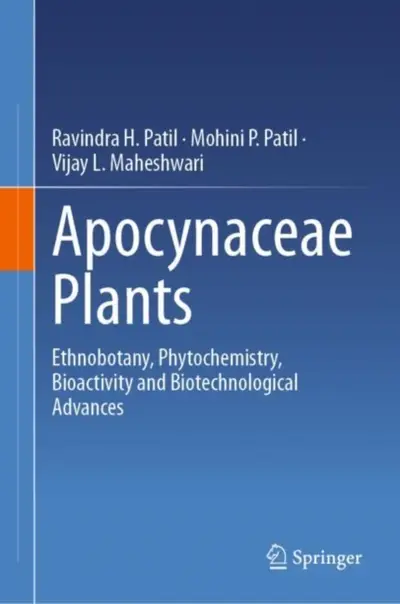
Apocynaceae Plants
Ethnobotany, Phytochemistry, Bioactivity and Biotechnological Advances
Price and availability
$188.99
Available in: Andorra, Austria, Australia, Belgium, Bulgaria, Canada, Switzerland, Cyprus, Czechia, Germany, Denmark, Estonia, Spain, Finland, France, United Kingdom, Guernsey, Greece, Croatia, Hungary, Ireland, Isle of Man, Iceland, Italy, Jersey, Japan, Liechtenstein, Lithuania, Luxembourg, Latvia, Monaco, Malta, Netherlands, Norway, Poland, Portugal, Romania, Sweden, Slovenia, Slovakia, San Marino, United States, Vatican City, South Africa
Stores: US, UK, Canada, EU, Australia.
Sign in to buyThe price is re-checked by the server before payment.
For personal use under the eBook licence.
- Format
- EPUB
- DRM
- Not stated by the publisher
- Language
- English
- Publisher
- Springer Nature Singapore
- Published
- 22 September 2023
- ISBN
- 9789819954063
- Subjects
- Botany & plant sciences, Biotechnology, Botany and plant sciences, Biotechnology
About this book
This book provides a concise overview of the Apocynaceae plant family, focusing on its morphology, diversity, ethnopharmacology, phytochemistry, and biological activities. It explores biotechnological advances in large-scale production of therapeutic bioactive compounds and conservation efforts using plant tissue culture. The family Apocynaceae is one of the largest and important families in angiosperm, with several members having medicinal properties used to treat various ailments. Most of them are consumed as food by tribal people, while a few plants are used as a source of poison, insecticides, gum, and many other important products. Members of this family are rich in alkaloids, terpenoids, steroids, flavonoids, glycosides, simple phenols, lactones and hydrocarbons. Other compounds such as sterols, lignans, and sugars have also been systematically studied. Extracts and isolated compounds from Apocynaceae members exhibit antioxidant, anti-inflammatory, antimicrobial, and cytotoxic activities. Notable plants like Holarrhena antidysenterica, Rauvolfia serpentina, Carissa carandas, and Tabernaemontana divaricata have been extensively researched. The family presents a diverse range of bioactive compounds with medicinal and pharmacological properties, holding promise for future applications. The book also covers endophytic microorganisms with their diversity, biological activities in Apocynaceae plants. It also highlights the role of endophytes in conservation of Apocynaceae plants. By identifying existing knowledge gaps, it aims to inspire further research in the field, making it a valuable resource for students and researchers in Life Sciences, agriculture, medicine, and pharmaceutical sciences.
Bibliographic data © Gardners Books Ltd.