PDF · English
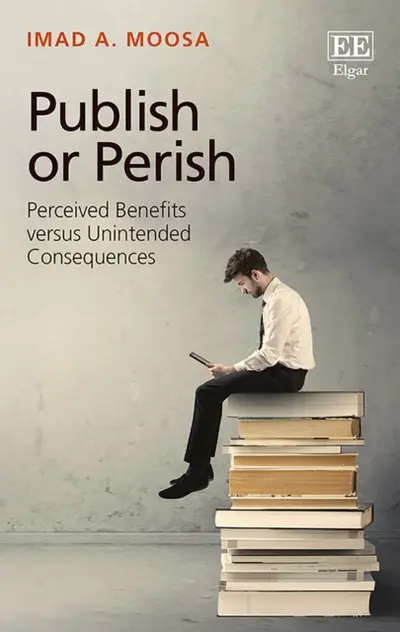
Publish or Perish
Perceived Benefits versus Unintended Consequences
Price and availability
$28.99
Available in: Andorra, Austria, Australia, Belgium, Bulgaria, Canada, Switzerland, Cyprus, Czechia, Germany, Denmark, Estonia, Spain, Finland, France, United Kingdom, Guernsey, Greece, Croatia, Hungary, Ireland, Isle of Man, Iceland, Italy, Jersey, Japan, Liechtenstein, Lithuania, Luxembourg, Latvia, Monaco, Malta, Netherlands, Norway, Poland, Portugal, Romania, Sweden, Slovenia, Slovakia, San Marino, United States, Vatican City, South Africa
Stores: US, UK, Canada, EU, Australia.
Sign in to buyThe price is re-checked by the server before payment.
For personal use under the eBook licence.
- Format
- DRM
- Not stated by the publisher
- Language
- English
- Publisher
- Edward Elgar Publishing
- Published
- 26 January 2018
- ISBN
- 9781786434937
- Subjects
- Higher & further education, tertiary education, Universities, Careers guidance, Publishing industry & book trade, Higher education, tertiary education, Careers guidance, Publishing and book trade
About this book
Imad Moosa's thought-provoking book explores the contemporary doctrine that plagues the academic sphere: the principle of publish or perish. This book identifies the pressures placed upon academics to either publish their work regularly, or suffer the consequences, including lack of promotion, or even redundancy.Imad Moosa argues that this concept is a result of globalisation and the neo-liberal idea of treating higher education as a private good. Providing one of the first extensive analyses of this doctrine, the author identifies the overwhelmingly negative unintended consequences stemming from the pressure to publish research. He explores the detrimental effects of this burden, which includes the impact of drawing away the focus from educating students, to the declining quality of published research. The hazardous activity of journal ranking and resource-wasting research evaluation programmes are also considered, with the author ultimately proposing that the solution to this controversial issue is to go back to days gone by, prior to the dominance of the free market ideology.Innovative, provocative, and timely, this book will be a stimulating read for academics worldwide, as well as non-university researchers, university administrators, policymakers and government officials operating within the fields of higher education, science, and technology.
Bibliographic data © Gardners Books Ltd.