EPUB · English
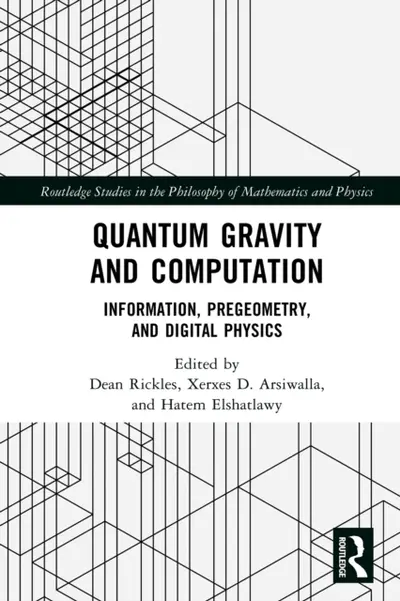
Quantum Gravity and Computation
Information, Pregeometry, and Digital Physics
Price and availability
$64.99
Available in: Andorra, Austria, Australia, Belgium, Bulgaria, Canada, Switzerland, Cyprus, Czechia, Germany, Denmark, Estonia, Spain, Finland, France, United Kingdom, Guernsey, Greece, Croatia, Hungary, Ireland, Isle of Man, Iceland, Italy, Jersey, Japan, Liechtenstein, Lithuania, Luxembourg, Latvia, Monaco, Malta, Netherlands, Norway, Poland, Portugal, Romania, Sweden, Slovenia, Slovakia, San Marino, United States, Vatican City, South Africa
Stores: US, UK, Canada, EU, Australia.
Sign in to buyThe price is re-checked by the server before payment.
For personal use under the eBook licence.
- Format
- EPUB
- DRM
- Not stated by the publisher
- Language
- English
- Publisher
- Taylor & Francis
- Published
- 23 December 2025
- ISBN
- 9781040675175
- Subjects
- Philosophy: logic, Philosophy of mathematics, Applied mathematics, Philosophy of science, Quantum physics (quantum mechanics & quantum field theory), Information technology: general issues, Computer science, Algebraic topology, Quantum physics (quantum mechanics and quantum field theory), Mathematical theory of computation
About this book
This volume argues that concepts from the theory of computation-including information theory, formal languages, and discrete structures-might provide novel paths towards a solution to the problem of quantum gravity. By combining elements of physics with computer science and mathematics, the volume proposes to transform the foundations of spacetime physics and bring it into the digital age.In recent years, it has become increasingly apparent a new theoretical framework will be needed to solve the problem of quantum gravity. This kind of framework-sometimes referred to as "e;pregeometry"e; or even "e;prephysics"e;-goes beyond conventional mathematical conceptions of space, time, and matter, seeking their building blocks in more fundamental elements. The essays in this volume explore this approach from a variety of perspectives, including physics-based, mathematical, computational, and philosophical. The new formal frameworks needed to discuss such approaches have their roots in homotopy type theory, formal language theory, and higher category theory; the computational perspective is informed by connections between pregeometric structures and formal proofs and programs. The new philosophical fulcrum supporting these new avenues is inspired by constructivism and meta-structures. By probing at a level of structure beneath the ordinary structures used in general relativity and quantum mechanics, this volume seeks to find new ways of showing how these higher-order structures can be constructed from the deeper elements. Quantum Gravity and Computation is an essential resource for scholars and graduate students interested in the philosophy of physics, quantum mechanics, and computational science.
Bibliographic data © Gardners Books Ltd.