PDF · English
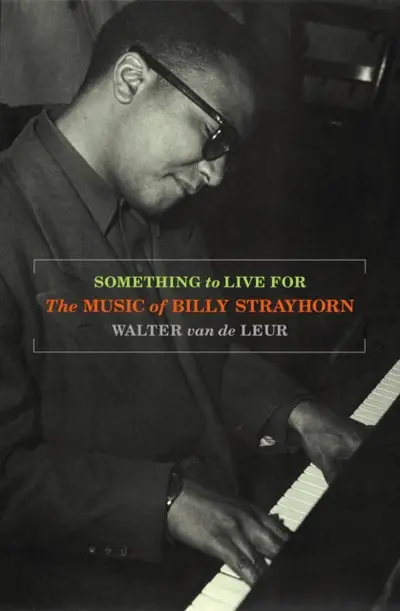
Something to Live For
The Music of Billy Strayhorn
Price and availability
$28.99
Available in: Andorra, Austria, Australia, Belgium, Bulgaria, Canada, Switzerland, Cyprus, Czechia, Germany, Denmark, Estonia, Spain, Finland, France, United Kingdom, Guernsey, Greece, Croatia, Hungary, Ireland, Isle of Man, Iceland, Italy, Jersey, Japan, Liechtenstein, Lithuania, Luxembourg, Latvia, Monaco, Malta, Netherlands, Norway, Poland, Portugal, Romania, Sweden, Slovenia, Slovakia, San Marino, United States, Vatican City, South Africa
Stores: US, UK, Canada, EU, Australia.
Sign in to buyThe price is re-checked by the server before payment.
For personal use under the eBook licence.
- Format
- DRM
- Not stated by the publisher
- Language
- English
- Publisher
- Oxford University Press
- Published
- 31 January 2002
- ISBN
- 9780198028857
- Subjects
- Jazz, Individual composers & musicians, specific bands & groups, Biography: arts & entertainment, AVLP, AVN, DNBF
About this book
Duke Ellington was one of jazz's greatest figures, a composer and bandleader of unparalleled importance and influence. But little attention has been given to his chief musical collaborator, Billy Strayhorn, who created hundreds of compositions and arrangements for his musical partner, and without whom the sound of Ellington's orchestra would have been very different. Now, in Walter van de Leur's provocative new book, Something To Live For, Billy Strayhorn steps out from Ellington's shadow and into the spotlight. Van de Leur argues that far from being merely a follower of Ellington or his alter ego, Strayhorn brought a radically new and visionary way of writing to the Ellington orchestra. Making extensive use, for the first time, of over 3,000 autograph scores, Van de Leur separates Strayhorn from Ellington, establishes who wrote what, and clearly distinguishes between their distinctive musical styles. "e;Both Strayhorn's and Ellington's oeuvres,"e; writes Van de Leur, "e;though historically intertwined, nevertheless form coherent, separate musical entities, especially in terms of harmonic, melodic, and structural design."e; Indeed, Something to Live For allows us to see the characteristic features of Strayhorn's compositions and arrangements, his "e;musical fingerprints,"e; and to analyze and evaluate his music on its own terms. The book also makes clear that Strayhorn's contribution to the band was much larger, and more original, than has been previously acknowledged. Based on a decade of research and offering detailed analyses of over 70 musical examples, Something to Live For casts new light--and will surely arouse intense debate--on two of the most important composers in the history of jazz.
Bibliographic data © Gardners Books Ltd.