PDF · English
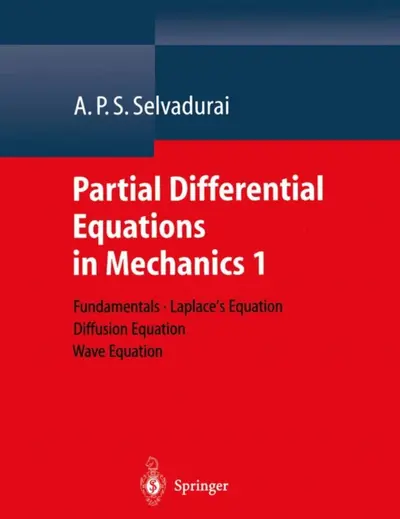
Partial Differential Equations in Mechanics 1
Fundamentals, Laplace''s Equation, Diffusion Equation, Wave Equation
Price and availability
$120.99
Available in: Andorra, Austria, Australia, Belgium, Bulgaria, Canada, Switzerland, Cyprus, Czechia, Germany, Denmark, Estonia, Spain, Finland, France, United Kingdom, Guernsey, Greece, Croatia, Hungary, Ireland, Isle of Man, Iceland, Italy, Jersey, Japan, Liechtenstein, Lithuania, Luxembourg, Latvia, Monaco, Malta, Netherlands, Norway, Poland, Portugal, Romania, Sweden, Slovenia, Slovakia, San Marino, United States, Vatican City, South Africa
Stores: US, UK, Canada, EU, Australia.
Sign in to buyThe price is re-checked by the server before payment.
For personal use under the eBook licence.
- Format
- DRM
- Not stated by the publisher
- Language
- English
- Publisher
- Springer Berlin Heidelberg
- Published
- 17 April 2013
- ISBN
- 9783662040065
- Subjects
- Differential calculus & equations, Mechanical engineering & materials, Calculus and mathematical analysis, Differential calculus and equations, Classical mechanics, Maths for engineers, Mechanical engineering, Engineering: Mechanics of solids
About this book
"e;Por he who knows not mathematics cannot know any other sciences; what is more, he cannot discover his own ignorance or find its proper remedies. "e; [Opus Majus] Roger Bacon (1214-1294) The material presented in these monographs is the outcome of the author's long-standing interest in the analytical modelling of problems in mechanics by appeal to the theory of partial differential equations. The impetus for writing these volumes was the opportunity to teach the subject matter to both undergraduate and graduate students in engineering at several universi- ties. The approach is distinctly different to that wh ich would adopted should such a course be given to students in pure mathematics; in this sense, the teaching of partial differential equations within an engineering curriculum should be viewed in the broader perspective of "e;The Modelling 0/ Problems in Engineering"e; . An engineering student should be given the opportunity to appreciate how the various combination of balance laws, conservation equations, kinematic constraints, constitutive responses, thermodynamic re- strictions, etc. , culminates in the development of a partial differential equa- tion, or sets of partial differential equations, with potential for applications to engineering problems. This ability to distill all the diverse information about a physical or mechanical process into partial differential equations is a particular attraction of the subject area.
Bibliographic data © Gardners Books Ltd.