EPUB · English
Heritage, Memory, and Punishment
Remembering Colonial Prisons in East Asia
- History
- Society & social sciences
- Politics & law
- Nature, environment & geography
- Arts, music & film
- Reference
Price and availability
$66.99
Available in: Andorra, Austria, Australia, Belgium, Bulgaria, Canada, Switzerland, Cyprus, Czechia, Germany, Denmark, Estonia, Spain, Finland, France, United Kingdom, Guernsey, Greece, Croatia, Hungary, Ireland, Isle of Man, Iceland, Italy, Jersey, Japan, Liechtenstein, Lithuania, Luxembourg, Latvia, Monaco, Malta, Netherlands, Norway, Poland, Portugal, Romania, Sweden, Slovenia, Slovakia, San Marino, United States, Vatican City, South Africa
Stores: US, UK, Canada, EU, Australia.
Sign in to buyThe price is re-checked by the server before payment.
For personal use under the eBook licence.
- Format
- EPUB
- DRM
- Not stated by the publisher
- Language
- English
- Publisher
- Taylor & Francis
- Published
- 23 September 2019
- ISBN
- 9781351810746
- Subjects
- Asia, East Asia, Far East, Taiwan, Museology & heritage studies, Regional studies, Cultural studies, Urban communities, Sociology, Crime & criminology, Legal history, Human geography, History of architecture, Museology and heritage studies, Penology and punishment, Asian history, Colonialism and imperialism
About this book
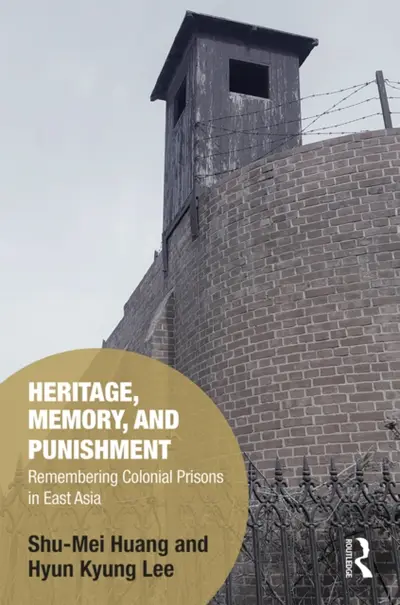
Based on a transnational study of decommissioned, postcolonial prisons in Taiwan (Taipei and Chiayi), South Korea (Seoul), and China (Lushun), this book offers a critical reading of prisons as a particular colonial product, the current restoration of which as national heritage is closely related to the evolving conceptualization of punishment. Focusing on the colonial prisons built by the Japanese Empire in the first half of the twentieth century, it illuminates how punishment has been considered a subject of modernization, while the contemporary use of prisons as heritage tends to reduce the process of colonial modernity to oppression and atrocity - thus constituting a heritage of shame and death, which postcolonial societies blame upon the former colonizers. A study of how the remembering of punishment and imprisonment reflects the attempts of postcolonial cities to re-articulate an understanding of the present by correcting the past, Heritage, Memory, and Punishment examines how prisons were designed, built, partially demolished, preserved, and redeveloped across political regimes, demonstrating the ways in which the selective use of prisons as heritage, reframed through nationalism, leaves marks on urban contexts that remain long after the prisons themselves are decommissioned. As such, it will appeal to scholars of sociology, geography, the built environment, and heritage with interests in memory studies and dark tourism.
Bibliographic data © Gardners Books Ltd.