PDF · English
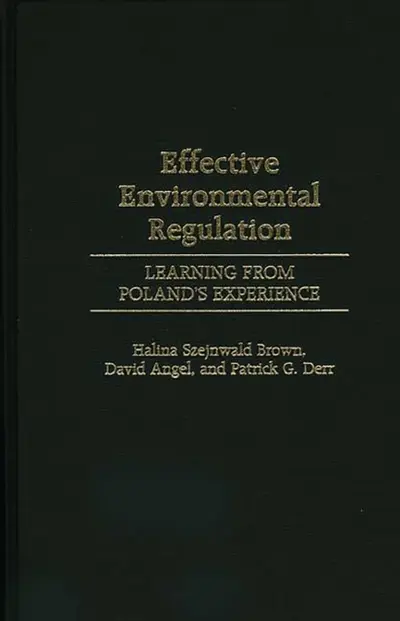
Effective Environmental Regulation
Learning from Poland''s Experience
Price and availability
$91.99
Available in: Andorra, Austria, Australia, Belgium, Bulgaria, Canada, Switzerland, Cyprus, Czechia, Germany, Denmark, Estonia, Spain, Finland, France, United Kingdom, Guernsey, Greece, Croatia, Hungary, Ireland, Isle of Man, Iceland, Italy, Jersey, Japan, Liechtenstein, Lithuania, Luxembourg, Latvia, Monaco, Malta, Netherlands, Norway, Poland, Portugal, Romania, Sweden, Slovenia, Slovakia, San Marino, United States, Vatican City, South Africa
Stores: US, UK, Canada, EU, Australia.
Sign in to buyThe price is re-checked by the server before payment.
For personal use under the eBook licence.
- Format
- DRM
- Not stated by the publisher
- Language
- English
- Publisher
- Bloomsbury Publishing (USA)
- Published
- 30 July 2000
- Pages
- 248
- ISBN
- 9780313003196
- Subjects
- Poland, Politics & government, Environmental economics, International environmental law, Politics and government, KCVG, Public international law: environment
About this book
Challenging views prevalent among Western and Polish scholars, this book explains Poland's surprising success in developing effective environmental and occupational regulatory systems while achieving remarkable socioeconomic growth, despite the toxic legacy of the Communist era. It offers rich insights into the questions of how one can achieve both economic growth and improved environmental and safety protection, and of the extent to which regulatory systems can be transferred across national and cultural boundaries. The authors develop a theoretical framework for assessing regulatory success, then use it to analyze Poland's recent experience. Grounded in five case studies of recently privatized firms, the analysis also presents a new survey of privately owned firms, extensive policy and data analysis, and interviews with key policy leaders, entrepreneurs, and intellectuals.The book points to case-specific decision making and information richness as key dimensions of an effective regulatory system and considers in depth the extent to which information richness is culturally dependent, and hence its portability as a policy tool. Addressing regulatory issues that are specific to both the United States and the international development community, the book makes a significant contribution to advancing the theoretical and conceptual frameworks used to explain the success, or lack of success, of regulatory systems.
Bibliographic data © Gardners Books Ltd.