PDF · English
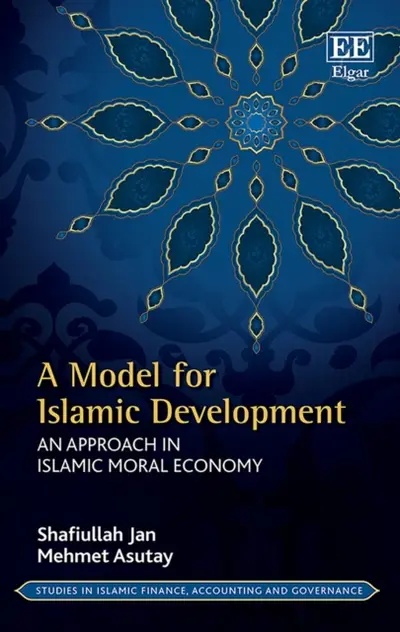
Model for Islamic Development
An Approach in Islamic Moral Economy
Price and availability
$33.99
Available in: Andorra, Austria, Australia, Belgium, Bulgaria, Canada, Switzerland, Cyprus, Czechia, Germany, Denmark, Estonia, Spain, Finland, France, United Kingdom, Guernsey, Greece, Croatia, Hungary, Ireland, Isle of Man, Iceland, Italy, Jersey, Japan, Liechtenstein, Lithuania, Luxembourg, Latvia, Monaco, Malta, Netherlands, Norway, Poland, Portugal, Romania, Sweden, Slovenia, Slovakia, San Marino, United States, Vatican City, South Africa
Stores: US, UK, Canada, EU, Australia.
Sign in to buyThe price is re-checked by the server before payment.
For personal use under the eBook licence.
- Format
- DRM
- Not stated by the publisher
- Language
- English
- Publisher
- Edward Elgar Publishing
- Published
- 26 July 2019
- ISBN
- 9781788116732
- Subjects
- Islamic studies, Development economics & emerging economies, Finance, Social groups: religious groups and communities, Development economics and emerging economies, Finance and the finance industry
About this book
This book explores and analyses economic development within Islamic Moral Economy (IME), which is proposed as an alternative economic and social system to capitalism and socialism. It presents a new model of Islamic development based on the substantive morality of Islam via micro dynamics expressed through an Islamic framework of spiritual development. Shafiullah Jan and Mehmet Asutay argue that the observed development failures of Muslim countries to provide basic necessities and an environment free of oppression and injustice can be overcome with an authentic Islamic development framework and its corresponding value system explored in the book, rather than the existing Eurocentric theory and policy making. In addition, it identifies the theological, political, social and economic boundaries for changing society to produce IME oriented development. Utilising a novel approach to development in Islam, through its substantive ethical and moral framework, the authors critically examine and evaluate the progress of Islamic banking and finance institutions in relation to its aspirations as identified by IME. Advanced Islamic economics and finance scholars will find this a useful source as it explores the intersection between Islamic development and the moral economy. The book will also be a valuable reference for those seeking to align public policies with ethical and moral Islamic frameworks.
Bibliographic data © Gardners Books Ltd.