PDF · English
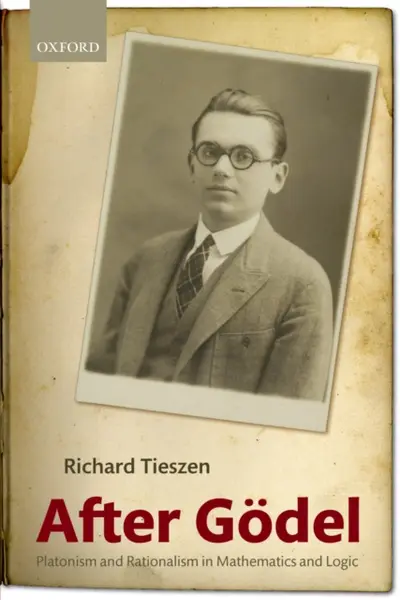
After Godel
Platonism and Rationalism in Mathematics and Logic
Price and availability
$44.99
Available in: Andorra, Austria, Australia, Belgium, Bulgaria, Canada, Switzerland, Cyprus, Czechia, Germany, Denmark, Estonia, Spain, Finland, France, United Kingdom, Guernsey, Greece, Croatia, Hungary, Ireland, Isle of Man, Iceland, Italy, Jersey, Japan, Liechtenstein, Lithuania, Luxembourg, Latvia, Monaco, Malta, Netherlands, Norway, Poland, Portugal, Romania, Sweden, Slovenia, Slovakia, San Marino, United States, Vatican City, South Africa
Stores: US, UK, Canada, EU, Australia.
Sign in to buyThe price is re-checked by the server before payment.
For personal use under the eBook licence.
- Format
- DRM
- Not stated by the publisher
- Language
- English
- Publisher
- Oxford University Press
- Published
- 5 May 2011
- ISBN
- 9780191619311
- Subjects
- Philosophy: metaphysics & ontology, Philosophy: logic, Philosophy of mathematics, Philosophy of mathematics, Philosophy: metaphysics and ontology, Philosophy: logic
About this book
Richard Tieszen presents an analysis, development, and defense of a number of central ideas in Kurt Godel's writings on the philosophy and foundations of mathematics and logic. Tieszen structures the argument around Godel's three philosophical heroes - Plato, Leibniz, and Husserl - and his engagement with Kant, and supplements close readings of Godel's texts on foundations with materials from Godel's Nachlass and from Hao Wang's discussions with Godel. As well as providing discussions of Godel's views on the philosophical significance of his technical results on completeness, incompleteness, undecidability, consistency proofs, speed-up theorems, and independence proofs, Tieszen furnishes a detailed analysis of Godel's critique of Hilbert and Carnap, and of his subsequent turn to Husserl's transcendental philosophy in 1959. On this basis, a new type of platonic rationalism that requires rational intuition, called 'constituted platonism', is developed and defended. Tieszen shows how constituted platonism addresses the problem of the objectivity of mathematics and of the knowledge of abstract mathematical objects. Finally, he considers the implications of this position for the claim that human minds ('monads') are machines, and discusses the issues of pragmatic holism and rationalism.
Bibliographic data © Gardners Books Ltd.