PDF · English
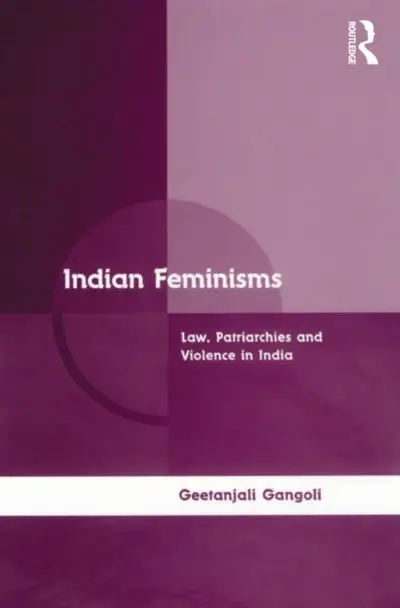
Indian Feminisms
Law, Patriarchies and Violence in India
Price and availability
$63.99
Available in: Andorra, Austria, Australia, Belgium, Bulgaria, Canada, Switzerland, Cyprus, Czechia, Germany, Denmark, Estonia, Spain, Finland, France, United Kingdom, Guernsey, Greece, Croatia, Hungary, Ireland, Isle of Man, Iceland, Italy, Jersey, Japan, Liechtenstein, Lithuania, Luxembourg, Latvia, Monaco, Malta, Netherlands, Norway, Poland, Portugal, Romania, Sweden, Slovenia, Slovakia, San Marino, United States, Vatican City, South Africa
Stores: US, UK, Canada, EU, Australia.
Sign in to buyThe price is re-checked by the server before payment.
For personal use under the eBook licence.
- Format
- DRM
- Not stated by the publisher
- Language
- English
- Publisher
- Taylor & Francis
- Published
- 23 May 2016
- ISBN
- 9781317117469
- Subjects
- Feminism & feminist theory, Gender studies, gender groups, Sociology, Anthropology, Social work, Crime & criminology, Jurisprudence & general issues, Criminal law & procedure, Family law, Health & personal development, India, Gender studies: women and girls, Pressure groups, protest movements and non-violent action, Law: Human rights and civil liberties, Criminal law: Gender violence
About this book
Contributing to debates on feminism, this book considers the impact made by feminists in India from the 1970s. Geetanjali Gangoli analyses feminist campaigns on issues of violence and women's rights, and debates on ways in which feminist legal debates may be limiting for women and based on exclusionary concepts such as citizenship. She addresses campaigns ranging from domestic violence, rape, pornography and son preference and sets them within a wider analysis of the position of women within the Indian state. The strengths and limitations of law reform for women are addressed as well as whether legal feminisms relating to law and women's legal rights are effective in the Indian context. The question of whether legal campaigns can make positive changes in women's lives or whether they further legitimize oppressive state patriarchies is considered. The recasting of caste and community identities is also assessed, as well as the rise of Hindu fundamentalism and the ways in which feminists in India have combated and confronted these challenges. Indian Feminisms will interest researchers and students in the areas of feminism, law, women's movements and social movements in India, and South Asia more generally.
Bibliographic data © Gardners Books Ltd.