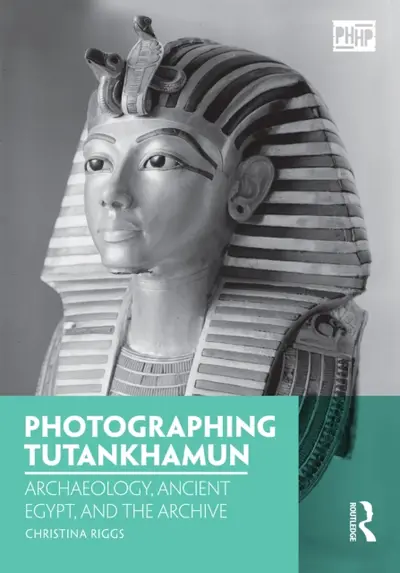
PDF · English
Photographing Tutankhamun
Archaeology, Ancient Egypt, and the Archive
Price and availability
$39.99
Available in: Andorra, Austria, Australia, Belgium, Bulgaria, Canada, Switzerland, Cyprus, Czechia, Germany, Denmark, Estonia, Spain, Finland, France, United Kingdom, Guernsey, Greece, Croatia, Hungary, Ireland, Isle of Man, Iceland, Italy, Jersey, Japan, Liechtenstein, Lithuania, Luxembourg, Latvia, Monaco, Malta, Netherlands, Norway, Poland, Portugal, Romania, Sweden, Slovenia, Slovakia, San Marino, United States, Vatican City, South Africa
Stores: US, UK, Canada, EU, Australia.
Sign in to buyThe price is re-checked by the server before payment.
For personal use under the eBook licence.
- Format
- DRM
- Not stated by the publisher
- Language
- English
- Publisher
- Taylor & Francis
- Published
- 19 September 2020
- ISBN
- 9781000211641
- Subjects
- Ancient Egypt, Photographs: collections, Egyptian archaeology / Egyptology, Egypt, Graphic design, Museology and heritage studies, Archaeological science, methodology and techniques
About this book
They are among the most famous and compelling photographs ever made in archaeology: Howard Carter kneeling before the burial shrines of Tutankhamun; life-size statues of the boy king on guard beside a doorway, tantalizingly sealed, in his tomb; or a solid gold coffin still draped with flowers cut more than 3,300 years ago. Yet until now, no study has explored the ways in which photography helped mythologize the tomb of Tutankhamun, nor the role photography played in shaping archaeological methods and interpretations, both in and beyond the field. This book undertakes the first critical analysis of the photographic archive formed during the ten-year clearance of the tomb, and in doing so explores the interface between photography and archaeology at a pivotal time for both. Photographing Tutankhamun foregrounds photography as a material, technical, and social process in early 20th-century archaeology, in order to question how the photograph made and remade 'ancient Egypt' in the waning age of colonial order.
Bibliographic data © Gardners Books Ltd.