PDF · English
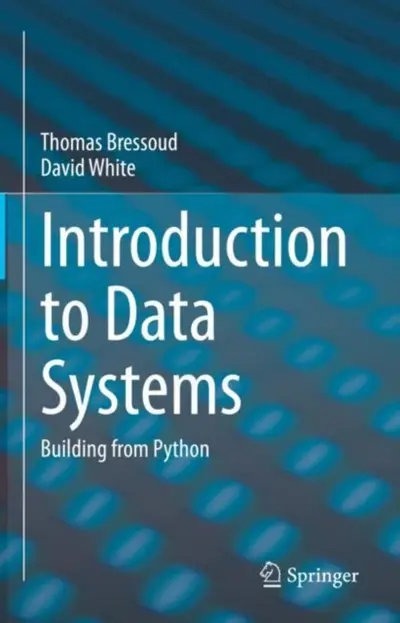
Introduction to Data Systems
Building from Python
Price and availability
$60.99
Available in: Andorra, Austria, Australia, Belgium, Bulgaria, Canada, Switzerland, Cyprus, Czechia, Germany, Denmark, Estonia, Spain, Finland, France, United Kingdom, Guernsey, Greece, Croatia, Hungary, Ireland, Isle of Man, Iceland, Italy, Jersey, Japan, Liechtenstein, Lithuania, Luxembourg, Latvia, Monaco, Malta, Netherlands, Norway, Poland, Portugal, Romania, Sweden, Slovenia, Slovakia, San Marino, United States, Vatican City, South Africa
Stores: US, UK, Canada, EU, Australia.
Sign in to buyThe price is re-checked by the server before payment.
For personal use under the eBook licence.
- Format
- DRM
- Not stated by the publisher
- Language
- English
- Publisher
- Springer International Publishing
- Published
- 4 December 2020
- ISBN
- 9783030543716
- Subjects
- Information theory, Probability & statistics, Network hardware, Algorithms & data structures, Programming & scripting languages: general, Databases, Data mining, Computer networking & communications, Artificial intelligence, Expert systems / knowledge-based systems, Information theory, Network hardware, Algorithms and data structures, Programming and scripting languages: general, Databases / Data management, Data mining, Artificial intelligence (AI), Expert systems / knowledge-based systems
About this book
Encompassing a broad range of forms and sources of data, this textbook introduces data systems through a progressive presentation. Introduction to Data Systems covers data acquisition starting with local files, then progresses to data acquired from relational databases, from REST APIs and through web scraping. It teaches data forms/formats from tidy data to relationally defined sets of tables to hierarchical structure like XML and JSON using data models to convey the structure, operations, and constraints of each data form.The starting point of the book is a foundation in Python programming found in introductory computer science classes or short courses on the language, and so does not require prerequisites of data structures, algorithms, or other courses. This makes the material accessible to students early in their educational career and equips them with understanding and skills that can be applied in computer science, data science/data analytics, and information technology programs as well as for internships and research experiences. This book is accessible to a wide variety of students. By drawing together content normally spread across upper level computer science courses, it offers a single source providing the essentials for data science practitioners. In our increasingly data-centric world, students from all domains will benefit from the "e;data-aptitude"e; built by the material in this book.
Bibliographic data © Gardners Books Ltd.