PDF · English
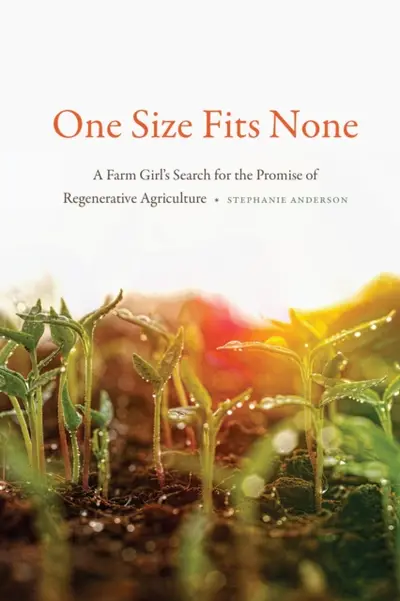
One Size Fits None
A Farm Girl's Search for the Promise of Regenerative Agriculture
Price and availability
Not sold in this region
Available in: Andorra, Austria, Australia, Belgium, Bulgaria, Switzerland, Cyprus, Czechia, Germany, Denmark, Estonia, Spain, Finland, France, United Kingdom, Guernsey, Greece, Croatia, Hungary, Ireland, Isle of Man, Iceland, Italy, Jersey, Japan, Liechtenstein, Lithuania, Luxembourg, Latvia, Monaco, Malta, Netherlands, Norway, Poland, Portugal, Romania, Sweden, Slovenia, Slovakia, San Marino, Vatican City, South Africa
Stores: UK, EU, Australia. Not available in the United States store.
This title cannot be bought in this store yet: its supplier terms, territorial rights or price are still being confirmed.
For personal use under the eBook licence.
- Format
- DRM
- Not stated by the publisher
- Language
- English
- Publisher
- University of Nebraska Press
- Published
- 1 January 2019
- ISBN
- 9781496211941
- Subjects
- Food & society, Food security & supply, Sustainable agriculture, Cultural studies: food and society, Sustainable agriculture
About this book
2019 Midwest Book Award for Nature 2020 High Plains Book Award Finalist 2020 Silver Nautilus Book Award Winner in Green Living and Sustainability Sustainable has long been the rallying cry of agricultural progressives; given that much of our nations farm and ranch land is already degraded, however, sustainable agriculture often means maintaining a less-than-ideal status quo. Industrial agriculture has also co-opted the term for marketing purposes without implementing better practices. Stephanie Anderson argues that in order to provide nutrient-rich food and fight climate change, we need to move beyond sustainable to regenerative agriculture, a practice that is highly tailored to local environments and renews resources. In One Size Fits None Anderson follows diverse farmers across the United States: a South Dakota bison rancher who provides an alternative to the industrial feedlot; an organic vegetable farmer in Florida who harvests microgreens; a New Mexico super-small farmer who revitalizes communities; and a North Dakota midsize farmer who combines livestock and grain farming to convert expensive farmland back to native prairie. The use of these nontraditional agricultural techniques show how varied operations can give back to the earth rather than degrade it. This book will resonate with anyone concerned about the future of food in America, providing guidance for creating a better, regenerative agricultural future.Download a discussion guide (PDF).
Bibliographic data © Gardners Books Ltd.