PDF · English
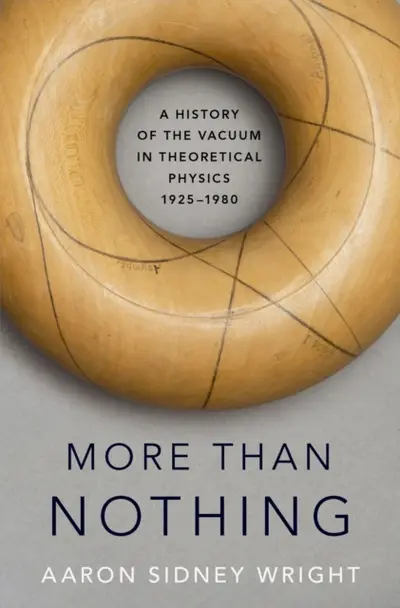
More than Nothing
A History of the Vacuum in Theoretical Physics, 1925-1980
Price and availability
$82.99
Available in: Andorra, Austria, Australia, Belgium, Bulgaria, Canada, Switzerland, Cyprus, Czechia, Germany, Denmark, Estonia, Spain, Finland, France, United Kingdom, Guernsey, Greece, Croatia, Hungary, Ireland, Isle of Man, Iceland, Italy, Jersey, Japan, Liechtenstein, Lithuania, Luxembourg, Latvia, Monaco, Malta, Netherlands, Norway, Poland, Portugal, Romania, Sweden, Slovenia, Slovakia, San Marino, United States, Vatican City, South Africa
Stores: US, UK, Canada, EU, Australia.
Sign in to buyThe price is re-checked by the server before payment.
For personal use under the eBook licence.
- Format
- DRM
- Not stated by the publisher
- Language
- English
- Publisher
- Oxford University Press
- Published
- 26 February 2024
- ISBN
- 9780190062811
- Subjects
- History of the Americas, Impact of science & technology on society, History of science, NHK, Impact of science and technology on society, History of science
About this book
The vacuum is central to physicists' best theories of subatomic particles, gravitation, and cosmology. Nothingness provides the reference point with which to compare new particle creation and annihilation. Cosmologists use empty universes to study the causal structure of spacetime. Paradoxically, our best physical theories of particles, gravity, and spacetime are theories of nothingness. Stranger still, the physicists' vacuum is a hive of activity. Quantum fluctuations fill empty space with particles, and astronomers measure gravitational waves, the vibrations of empty spacetime itself. More than Nothing uses the history of the vacuum to show how technical concepts in physics are made real through everyday practice. It provides new insight into the development of twentieth-century theoretical physics through sustained analysis of understudied figures including John Wheeler's geometrodynamics and Sidney Coleman's false vacuum. It reveals the surprising influence on physicists from the psychology of impossible objects to drawings of the black hole, and the ways in which the development of the physics of the vacuum became inseparable from the development of larger cultural movements in aesthetics, art, psychology, and fiction. Across decades and across disciplines, More than Nothing shows how physicists over and again chose to study the vacuum for insight into the world around them. Drawing on newly unearthed laboratory notes, private letters, and published material, More than Nothing offers a scoping history of the vacuum as a lens into the development of modern physics.
Bibliographic data © Gardners Books Ltd.