PDF · English
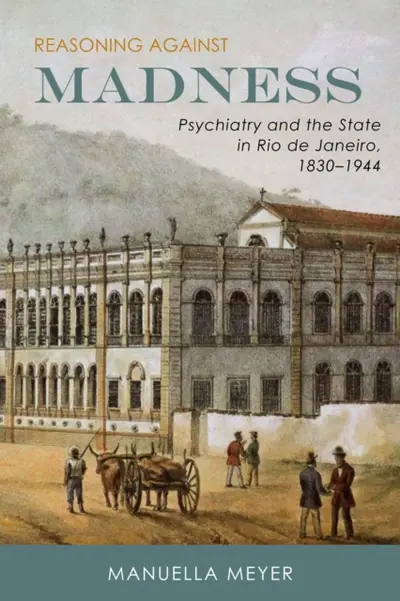
Reasoning against Madness
Psychiatry and the State in Rio de Janeiro, 1830-1944
Price and availability
Price unavailable
Available in: Andorra, Austria, Australia, Belgium, Bulgaria, Canada, Switzerland, Cyprus, Czechia, Germany, Denmark, Estonia, Spain, Finland, France, United Kingdom, Guernsey, Greece, Croatia, Hungary, Ireland, Isle of Man, Iceland, Italy, Jersey, Japan, Liechtenstein, Lithuania, Luxembourg, Latvia, Monaco, Malta, Netherlands, Norway, Poland, Portugal, Romania, Sweden, Slovenia, Slovakia, San Marino, United States, Vatican City, South Africa
Stores: US, UK, Canada, EU, Australia.
This title cannot be bought in this store yet: its supplier terms, territorial rights or price are still being confirmed.
For personal use under the eBook licence.
- Format
- DRM
- Not stated by the publisher
- Language
- English
- Publisher
- Boydell & Brewer Ltd
- Published
- 20 June 2017
- Pages
- 262
- ISBN
- 9781787440425
- Subjects
- Brazil, c 1800 to c 1900, 20th century, General & world history, History of the Americas, Mental health services, History of medicine, Psychiatry, The Americas, History of medicine, History of the Americas
About this book
Examines the emergence of Brazilian psychiatry during a period of national regeneration, demonstrating how sociopolitical negotiations can shape psychiatric professionalizationReasoning against Madness: Psychiatry and the State in Rio de Janeiro, 1830-1944 examines the emergence of Brazilian psychiatry, looking at how its practitioners fashioned themselves as the key architects in the project ofnational regeneration. The book's narrative involves a cast of varied characters in an unstable context: psychiatrists, Catholic representatives, spiritist leaders, state officials, and the mentally ill, all caught in the shiftinglandscape of modern state formation. Manuella Meyer investigates the key junctures at which psychiatrists sought to establish their authority and the ways in which their adversaries challenged this authority. These moments serve as productive points from which to explore the moral and political economies of mental health, demonstrating how sociopolitical negotiations shape psychiatric professionalization. Meyer argues that the gradual adoptionof punitive configurations of insanity helped sanction socioeconomic and political inequalities during a time of rapid socioeconomic, political, and cultural transformation. Manuella Meyer is Associate Professor of History at the University of Richmond.
Bibliographic data © Gardners Books Ltd.