PDF · English
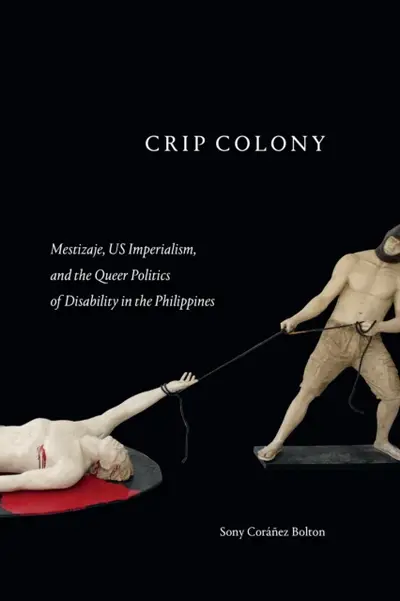
Crip Colony
Mestizaje, US Imperialism, and the Queer Politics of Disability in the Philippines
Price and availability
$35.99
Available in: Andorra, Austria, Australia, Belgium, Bulgaria, Canada, Switzerland, Cyprus, Czechia, Germany, Denmark, Estonia, Spain, Finland, France, United Kingdom, Guernsey, Greece, Croatia, Hungary, Ireland, Isle of Man, Iceland, Italy, Jersey, Japan, Liechtenstein, Lithuania, Luxembourg, Latvia, Monaco, Malta, Netherlands, Norway, Poland, Portugal, Romania, Sweden, Slovenia, Slovakia, San Marino, United States, Vatican City, South Africa
Stores: US, UK, Canada, EU, Australia.
Sign in to buyThe price is re-checked by the server before payment.
For personal use under the eBook licence.
- Format
- DRM
- Not stated by the publisher
- Language
- English
- Publisher
- Duke University Press
- Published
- 16 January 2023
- ISBN
- 9781478024187
- Subjects
- South East Asia, Asian history, Disability: social aspects, JBFM, NHF
About this book
In Crip Colony, Sony Coranez Bolton examines the racial politics of disability, mestizaje, and sexuality in the Philippines. Drawing on literature, poetry, colonial records, political essays, travel narratives, and visual culture, Coranez Bolton traces how disability politics colluded with notions of Philippine mestizaje. He demonstrates that Filipino mestizo writers in the late nineteenth and early twentieth centuries used mestizaje as a racial ideology of ability that marked Indigenous inhabitants of the Philippines as lacking in civilization and in need of uplift and rehabilitation. Heteronormative, able-bodied, and able-minded mixed-race Filipinos offered a model and path for assimilation into the US empire. In this way, mestizaje allowed for supposedly superior mixed-race subjects to govern the archipelago in collusion with American imperialism. By bringing disability studies together with studies of colonialism and queer-of-color critique, Coranez Bolton extends theorizations of mestizaje beyond the United States and Latin America while considering how Filipinx and Filipinx American thought fundamentally enhances understandings of the colonial body and the racial histories of disability.
Bibliographic data © Gardners Books Ltd.