EPUB · English
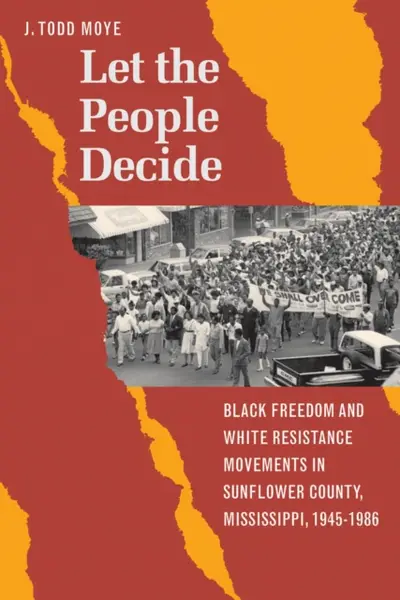
Let the People Decide
Black Freedom and White Resistance Movements in Sunflower County, Mississippi, 1945-1986
Price and availability
$31.99
Available in: Andorra, Austria, Australia, Belgium, Bulgaria, Canada, Switzerland, Cyprus, Czechia, Germany, Denmark, Estonia, Spain, Finland, France, United Kingdom, Guernsey, Greece, Croatia, Hungary, Ireland, Isle of Man, Iceland, Italy, Jersey, Japan, Liechtenstein, Lithuania, Luxembourg, Latvia, Monaco, Malta, Netherlands, Norway, Poland, Portugal, Romania, Sweden, Slovenia, Slovakia, San Marino, United States, Vatican City, South Africa
Stores: US, UK, Canada, EU, Australia.
Sign in to buyThe price is re-checked by the server before payment.
For personal use under the eBook licence.
- Format
- EPUB
- DRM
- Not stated by the publisher
- Language
- English
- Publisher
- The University of North Carolina Press
- Published
- 8 March 2006
- ISBN
- 9780807876701
- Subjects
- USA, Central Southern states, Mississippi, History of the Americas, Black & Asian studies, Civil rights & citizenship, United States of America, USA, US South, Human rights, civil rights, History of the Americas, Local history
About this book
In the middle of the Mississippi Delta lies rural, black-majority Sunflower County. J. Todd Moye examines the social histories of civil rights and white resistance movements in Sunflower, tracing the development of organizing strategies in separate racial communities over four decades.Sunflower County was home to both James Eastland, one of the most powerful reactionaries in the U.S. Senate in the twentieth century, and Fannie Lou Hamer, the freedom-fighting sharecropper who rose to national prominence as head of the Mississippi Freedom Democratic Party. Sunflower was the birthplace of the Citizens' Council, the white Souths pre-eminent anticivil rights organization, but it was also a hotbed of SNCC (Student Nonviolent Coordinating Committee) organizing and a fountainhead of freedom culture.Using extensive oral history interviews and archival research, Moye situates the struggle for democracy in Sunflower County within the context of national developments in the civil rights movement. Arguing that the civil rights movement cannot be understood as a national monolith, Moye reframes it as the accumulation of thousands of local movements, each with specific goals and strategies. By continuing the analysis into the 1980s, Let the People Decide pushes the boundaries of conventional periodization, recognizing the full extent of the civil rights movement.
Bibliographic data © Gardners Books Ltd.