PDF · English
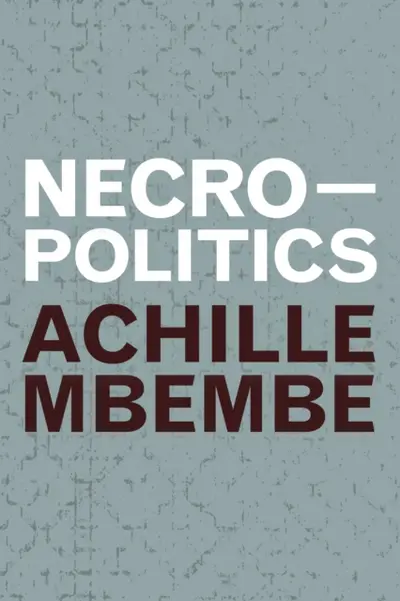
Necropolitics
Price and availability
$36.99
Available in: Andorra, Austria, Australia, Belgium, Bulgaria, Canada, Switzerland, Cyprus, Czechia, Germany, Denmark, Estonia, Spain, Finland, France, United Kingdom, Guernsey, Greece, Croatia, Hungary, Ireland, Isle of Man, Iceland, Italy, Jersey, Japan, Liechtenstein, Lithuania, Luxembourg, Latvia, Monaco, Malta, Netherlands, Norway, Poland, Portugal, Romania, Sweden, Slovenia, Slovakia, San Marino, United States, Vatican City
Stores: US, UK, Canada, EU, Australia.
Sign in to buyThe price is re-checked by the server before payment.
For personal use under the eBook licence.
- Format
- DRM
- Not stated by the publisher
- Language
- English
- Publisher
- Duke University Press
- Published
- 25 October 2019
- ISBN
- 9781478007227
- Subjects
- Social & cultural history, Social & political philosophy, Social discrimination & inequality, Ethnic studies, Ethnic minorities & multicultural studies, JBFA, JBSL, JBSL1, NHTB, QDTS
About this book
In Necropolitics Achille Mbembe, a leader in the new wave of francophone critical theory, theorizes the genealogy of the contemporary world, a world plagued by ever-increasing inequality, militarization, enmity, and terror as well as by a resurgence of racist, fascist, and nationalist forces determined to exclude and kill. He outlines how democracy has begun to embrace its dark side---what he calls its "e;nocturnal body"e;---which is based on the desires, fears, affects, relations, and violence that drove colonialism. This shift has hollowed out democracy, thereby eroding the very values, rights, and freedoms liberal democracy routinely celebrates. As a result, war has become the sacrament of our times in a conception of sovereignty that operates by annihilating all those considered enemies of the state. Despite his dire diagnosis, Mbembe draws on post-Foucauldian debates on biopolitics, war, and race as well as Fanon's notion of care as a shared vulnerability to explore how new conceptions of the human that transcend humanism might come to pass. These new conceptions would allow us to encounter the Other not as a thing to exclude but as a person with whom to build a more just world.
Bibliographic data © Gardners Books Ltd.