EPUB · English
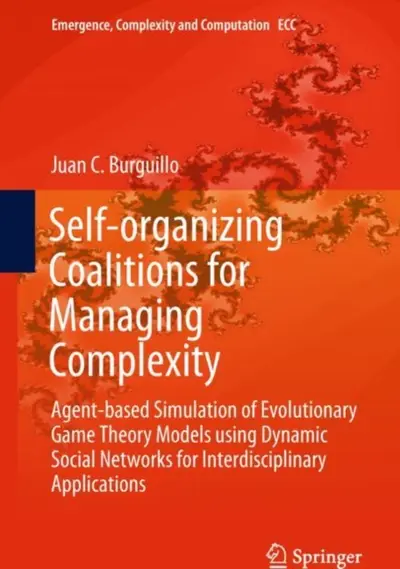
Self-organizing Coalitions for Managing Complexity
Agent-based Simulation of Evolutionary Game Theory Models using Dynamic Social Networks for Interdisciplinary Applications
Price and availability
$202.99
Available in: Andorra, Austria, Australia, Belgium, Bulgaria, Canada, Switzerland, Cyprus, Czechia, Germany, Denmark, Estonia, Spain, Finland, France, United Kingdom, Guernsey, Greece, Croatia, Hungary, Ireland, Isle of Man, Iceland, Italy, Jersey, Japan, Liechtenstein, Lithuania, Luxembourg, Latvia, Monaco, Malta, Netherlands, Norway, Poland, Portugal, Romania, Sweden, Slovenia, Slovakia, San Marino, United States, Vatican City, South Africa
Stores: US, UK, Canada, EU, Australia.
Sign in to buyThe price is re-checked by the server before payment.
For personal use under the eBook licence.
- Format
- EPUB
- DRM
- Not stated by the publisher
- Language
- English
- Publisher
- Springer International Publishing
- Published
- 13 December 2017
- ISBN
- 9783319698984
- Subjects
- Cybernetics & systems theory, Management decision making, Operational research, Discrete mathematics, Combinatorics & graph theory, Engineering: general, Maths for engineers, Artificial intelligence, Cybernetics and systems theory, Management decision making, Operational research, Combinatorics and graph theory, Maths for engineers, Artificial intelligence (AI)
About this book
This book provides an interdisciplinary approach to complexity, combining ideas from areas like complex networks, cellular automata, multi-agent systems, self-organization and game theory. The first part of the book provides an extensive introduction to these areas, while the second explores a range of research scenarios. Lastly, the book presents CellNet, a software framework that offers a hands-on approach to the scenarios described throughout the book. In light of the introductory chapters, the research chapters, and the CellNet simulating framework, this book can be used to teach undergraduate and master's students in disciplines like artificial intelligence, computer science, applied mathematics, economics and engineering. Moreover, the book will be particularly interesting for Ph.D. and postdoctoral researchers seeking a general perspective on how to design and create their own models.
Bibliographic data © Gardners Books Ltd.