PDF · English
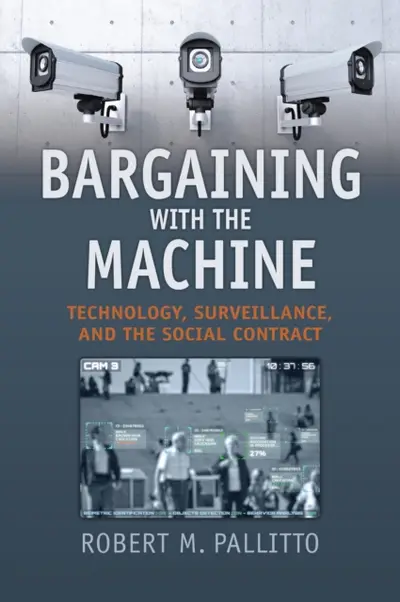
Bargaining with the Machine
Technology, Surveillence, and the Social Contract
Price and availability
$31.99
Available in: Andorra, Austria, Australia, Belgium, Bulgaria, Canada, Switzerland, Cyprus, Czechia, Germany, Denmark, Estonia, Spain, Finland, France, United Kingdom, Guernsey, Greece, Croatia, Hungary, Ireland, Isle of Man, Iceland, Italy, Jersey, Japan, Liechtenstein, Lithuania, Luxembourg, Latvia, Monaco, Malta, Netherlands, Norway, Poland, Portugal, Romania, Sweden, Slovenia, Slovakia, San Marino, United States, Vatican City, South Africa
Stores: US, UK, Canada, EU, Australia.
Sign in to buyThe price is re-checked by the server before payment.
For personal use under the eBook licence.
- Format
- DRM
- Not stated by the publisher
- Language
- English
- Publisher
- University Press of Kansas
- Published
- 5 January 2021
- ISBN
- 9780700629862
- Subjects
- Ethical issues & debates, International relations, Privacy law, Technology: general issues, Ethical & social aspects of IT, Ethical issues, topics and debates, Warfare and defence, Privacy law
About this book
Cell phone apps share location information; software companies store user data in the cloud; biometric scanners read fingerprints; employees of some businesses have microchips implanted in their hands. In each of these instances we trade a share of privacy or an aspect of identity for greater convenience or improved security. What Robert M. Pallitto asks in Bargaining with the Machine is whether we are truly making such bargains freelywhether, in fact, such a transaction can be conducted freely or advisedly in our ever more technologically sophisticated world.Pallitto uses the social theory of bargaining to look at the daily compromises we make with technology. Specifically, he explores whether resisting these bargains is still possible when the technologies in question are backed by persuasive, even coercive, corporate and state power. Who, he asks, is proposing the bargain? What is the balance of bargaining power? What is surrendered and what is gained? And are the perceived and the actual gains and losses the samethat is, what is hidden?At the center of Pallittos work is the paradox of bargaining in a world of limited agency. Assurances that we are in control are abundant whether we are consumers, voters, or party to the social contract. But when purchasing goods from a technological behemoth like Amazon, or when choosing a candidate whose image is crafted and shaped by campaign strategists and media outlets, how truly free, let alone informed, are our choices?The tension between claims of agency and awareness of its limits is the site where we experience our social livesand nowhere is this tension more pronounced than in the surveillance society. This book offers a cogent analysis of how that complex, contested, and even paradoxical experience arises as well as an unusually clear and troubling view of the consequential compromises we may be making.
Bibliographic data © Gardners Books Ltd.