PDF · English
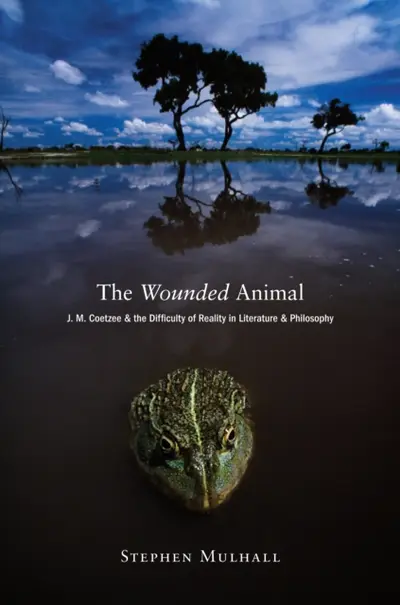
Wounded Animal
J. M. Coetzee and the Difficulty of Reality in Literature and Philosophy
Price and availability
$64.99
Available in: Andorra, Austria, Australia, Belgium, Bulgaria, Canada, Switzerland, Cyprus, Czechia, Germany, Denmark, Estonia, Spain, Finland, France, United Kingdom, Guernsey, Greece, Croatia, Hungary, Ireland, Isle of Man, Iceland, Italy, Jersey, Japan, Liechtenstein, Lithuania, Luxembourg, Latvia, Monaco, Malta, Netherlands, Norway, Poland, Portugal, Romania, Sweden, Slovenia, Slovakia, San Marino, United States, Vatican City, South Africa
Stores: US, UK, Canada, EU, Australia.
Sign in to buyThe price is re-checked by the server before payment.
For personal use under the eBook licence.
- Format
- DRM
- Not stated by the publisher
- Language
- English
- Publisher
- Princeton University Press
- Published
- 8 December 2008
- ISBN
- 9781400837533
- Subjects
- Literary theory, Literary studies: from c 1900 -, Literary studies: fiction, novelists & prose writers, Ethics & moral philosophy, Animals & society, Literary theory, Semiotics / semiology, Animals and society / Animal rights - issues and debates, Ethics and moral philosophy
About this book
In 1997, the Nobel Prize-winning novelist J. M. Coetzee, invited to Princeton University to lecture on the moral status of animals, read a work of fiction about an eminent novelist, Elizabeth Costello, invited to lecture on the moral status of animals at an American college. Coetzee's lectures were published in 1999 as The Lives of Animals, and reappeared in 2003 as part of his novel Elizabeth Costello; and both lectures and novel have attracted the critical attention of a number of influential philosophers--including Peter Singer, Cora Diamond, Stanley Cavell, and John McDowell. In The Wounded Animal, Stephen Mulhall closely examines Coetzee's writings about Costello, and the ways in which philosophers have responded to them, focusing in particular on their powerful presentation of both literature and philosophy as seeking, and failing, to represent reality--in part because of reality's resistance to such projects of understanding, but also because of philosophy's unwillingness to learn from literature how best to acknowledge that resistance. In so doing, Mulhall is led to consider the relations among reason, language, and the imagination, as well as more specific ethical issues concerning the moral status of animals, the meaning of mortality, the nature of evil, and the demands of religion. The ancient quarrel between philosophy and literature here displays undiminished vigor and renewed significance.
Bibliographic data © Gardners Books Ltd.