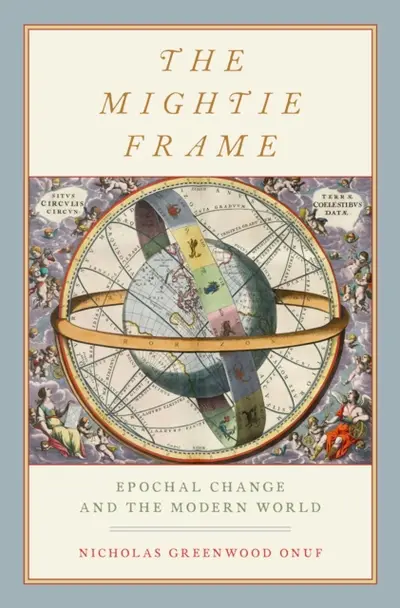
EPUB · English
Mightie Frame
Epochal Change and the Modern World
Price and availability
$33.99
Available in: Andorra, Austria, Australia, Belgium, Bulgaria, Canada, Switzerland, Cyprus, Czechia, Germany, Denmark, Estonia, Spain, Finland, France, United Kingdom, Guernsey, Greece, Croatia, Hungary, Ireland, Isle of Man, Iceland, Italy, Jersey, Japan, Liechtenstein, Lithuania, Luxembourg, Latvia, Monaco, Malta, Netherlands, Norway, Poland, Portugal, Romania, Sweden, Slovenia, Slovakia, San Marino, United States, Vatican City, South Africa
Stores: US, UK, Canada, EU, Australia.
Sign in to buyThe price is re-checked by the server before payment.
For personal use under the eBook licence.
- Format
- EPUB
- DRM
- Not stated by the publisher
- Language
- English
- Publisher
- Oxford University Press
- Published
- 5 July 2018
- ISBN
- 9780190879822
- Subjects
- Social & political philosophy, Political science & theory, International relations, Political science and theory, International relations, QDTS
About this book
Inspired by Michel Foucault's The Order of Things, this book tells a story about epochal change in the modern world. Like Foucault, Nicholas Onuf is concerned with how we moderns think about ourselves and our world, but in this book he emphasizes the conceptual links in the ways we think, talk, get things done, conduct ourselves, and run societies, from age to age. As with his previous work, Onuf emphasizes the "e;rules for rule"e; that have solidified over time through repeated behaviors that work themselves out into a system of social uniformity and hierarchy. Rules set out who is a member of society, establish goals, provide opportunities to act, and dictate who sits on top -- in other words, what any political society looks like in a particular time and place. This book looks at the political society that has evolved since the Renaissance, or what might be called "e;the modern world,"e; in order to consider what is yet to come. Onuf argues that modernity, although consisting of a succession of epochs or ages separated by great ruptures, has continued to change within the confines of a "e;mightie frame"e; (a turn of phrase he borrows from John Milton). Epoch by epoch, this frame has linked the limits of our knowledge, a la Michel Foucault, to conditions of rule, and it points to a plausible ethics for what comes next. But unlike Foucault, Onuf argues that modernism marked an end to societal and political transitions, and that we have entered a period during which established conditions of rule are likely to be reinforced -- and the mighty frame will grow ever mightier.
Bibliographic data © Gardners Books Ltd.