EPUB · English
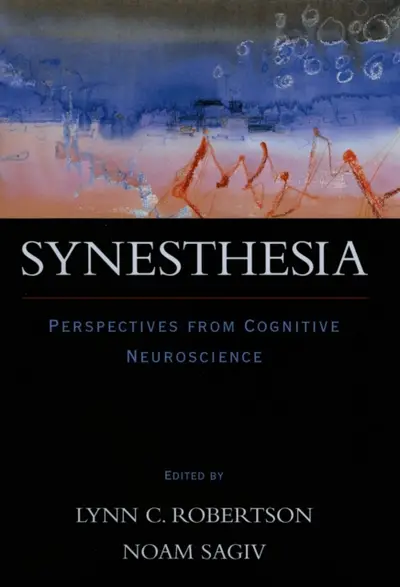
Synesthesia
Perspectives from Cognitive Neuroscience
Price and availability
$66.99
Available in: Andorra, Austria, Australia, Belgium, Bulgaria, Canada, Switzerland, Cyprus, Czechia, Germany, Denmark, Estonia, Spain, Finland, France, United Kingdom, Guernsey, Greece, Croatia, Hungary, Ireland, Isle of Man, Iceland, Italy, Jersey, Japan, Liechtenstein, Lithuania, Luxembourg, Latvia, Monaco, Malta, Netherlands, Norway, Poland, Portugal, Romania, Sweden, Slovenia, Slovakia, San Marino, United States, Vatican City, South Africa
Stores: US, UK, Canada, EU, Australia.
Sign in to buyThe price is re-checked by the server before payment.
For personal use under the eBook licence.
- Format
- EPUB
- DRM
- Not stated by the publisher
- Language
- English
- Publisher
- Oxford University Press
- Published
- 14 October 2004
- ISBN
- 9780190290283
- Subjects
- Physiological & neuro-psychology, biopsychology, Cognition & cognitive psychology, Neurology & clinical neurophysiology, Popular psychology, Physiological psychology, neuropsychology, biopsychology, Cognition and cognitive psychology, MKJ, Popular psychology
About this book
Owing to its bizarre nature and its implications for understanding how brains work, synesthesia has recently received a lot of attention in the popular press and motivated a great deal of research and discussion among scientists. The questions generated by these two communities are intriguing: Does the synesthetic phenomenon require awareness and attention? How does a feature that is not present become bound to one that is? Does synesthesia develop or is it hard wired? Should it change our way of thinking about perceptual experience in general? What is its value in understanding perceptual systems as a whole? This volume brings together a distinguished group of investigators from diverse backgrounds--among them neuroscientists, novelists, and synesthetes themselves--who provide fascinating answers to these questions. Although each approaches synesthesia from a very different perspective, and each was curious about and investigated synesthesia for very different reasons, the similarities between their work cannot be ignored. The research presented in this volume demonstrates that it is no longer reasonable to ask whether or not synesthesia is real--we must now ask how we can account for it from cognitive, neurobiological, developmental, and evolutionary perspectives. This book will be important reading for any scientist interested in brain and mind, not to mention synesthetes themselves, and others who might be wondering what all the fuss is about.
Bibliographic data © Gardners Books Ltd.