EPUB · English
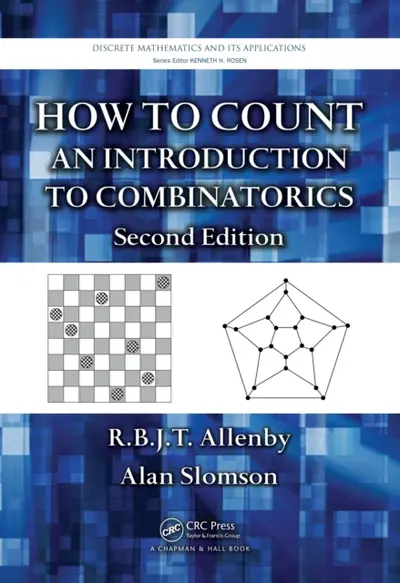
How to Count
An Introduction to Combinatorics, Second Edition
Price and availability
$60.99
Available in: Andorra, Austria, Australia, Belgium, Bulgaria, Canada, Switzerland, Cyprus, Czechia, Germany, Denmark, Estonia, Spain, Finland, France, United Kingdom, Guernsey, Greece, Croatia, Hungary, Ireland, Isle of Man, Iceland, Italy, Jersey, Japan, Liechtenstein, Lithuania, Luxembourg, Latvia, Monaco, Malta, Netherlands, Norway, Poland, Portugal, Romania, Sweden, Slovenia, Slovakia, San Marino, United States, Vatican City, South Africa
Stores: US, UK, Canada, EU, Australia.
Sign in to buyThe price is re-checked by the server before payment.
For personal use under the eBook licence.
- Format
- EPUB
- DRM
- Not stated by the publisher
- Language
- English
- Publisher
- CRC Press
- Published
- 12 August 2010
- ISBN
- 9781040063002
- Subjects
- Mathematics, Discrete mathematics, Algebra, Combinatorics & graph theory, Operating systems, Discrete mathematics, Combinatorics and graph theory
About this book
Emphasizes a Problem Solving ApproachA first course in combinatoricsCompletely revised, How to Count: An Introduction to Combinatorics, Second Edition shows how to solve numerous classic and other interesting combinatorial problems. The authors take an easily accessible approach that introduces problems before leading into the theory involved. Although the authors present most of the topics through concrete problems, they also emphasize the importance of proofs in mathematics.New to the Second EditionThis second edition incorporates 50 percent more material. It includes seven new chapters that cover occupancy problems, Stirling and Catalan numbers, graph theory, trees, Dirichlet's pigeonhole principle, Ramsey theory, and rook polynomials. This edition also contains more than 450 exercises. Ideal for both classroom teaching and self-study, this text requires only a modest amount of mathematical background. In an engaging way, it covers many combinatorial tools, such as the inclusion-exclusion principle, generating functions, recurrence relations, and Polya's counting theorem.
Bibliographic data © Gardners Books Ltd.