EPUB · English
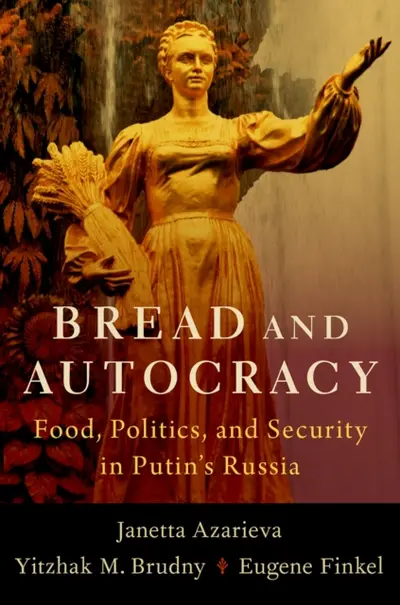
Bread and Autocracy
Food, Politics, and Security in Putin''s Russia
Price and availability
$20.99
Available in: Andorra, Austria, Australia, Belgium, Bulgaria, Canada, Switzerland, Cyprus, Czechia, Germany, Denmark, Estonia, Spain, Finland, France, United Kingdom, Guernsey, Greece, Croatia, Hungary, Ireland, Isle of Man, Iceland, Italy, Jersey, Japan, Liechtenstein, Lithuania, Luxembourg, Latvia, Monaco, Malta, Netherlands, Norway, Poland, Portugal, Romania, Sweden, Slovenia, Slovakia, San Marino, United States, Vatican City, South Africa
Stores: US, UK, Canada, EU, Australia.
Sign in to buyThe price is re-checked by the server before payment.
For personal use under the eBook licence.
- Format
- EPUB
- DRM
- Not stated by the publisher
- Language
- English
- Publisher
- Oxford University Press
- Published
- 18 August 2023
- ISBN
- 9780197684382
- Subjects
- International relations, Espionage & secret services, Geopolitics, International relations, Espionage and secret services, Geopolitics
About this book
Food has been crucial to the functioning and survival of governments and regimes since the emergence of early states. Yet, only in a few countries is the connection between food and politics as pronounced as in Russia. Since the 1917 Revolution, virtually every significant development in Russian and Soviet history has been either directly driven by or closely associated with the question of food and access to it. In fact, food shortages played a critical role in the collapse of both the Russian Empire and the USSR. Under Putin's watch, Russia moved from heavily relying on grain imports to feed the population to being one of the world's leading food exporters. In Bread and Autocracy, Janetta Azarieva, Yitzhak M. Brudny, and Eugene Finkel focus on this crucial yet widely overlooked transformation, as well as its causes and consequences for Russia's domestic and foreign politics. The authors argue that Russia's food independence agenda is an outcome of a deliberate, decades-long policy to better prepare the country for a confrontation with the West. Moreover, they show that for the Kremlin, nutritional self-sufficiency and domestic food production is a crucial pillar of state security and regime survival. Azarieva, Brudny, and Finkel also make the case that Russia's focus on food independence also sets the country apart from almost all modern autocracies. While many authoritarian regimes have adopted industrial import-substitution policies, in Putin's Russia it is the substitution of food imports with domestically produced crops that is crucial for regime survival. As food reemerges as a key global issue and nations increasingly turn inwards, Bread and Autocracy provides a timely and comprehensive look into Russia's experience in building a nutritionally autarkic dictatorship.
Bibliographic data © Gardners Books Ltd.