EPUB · English
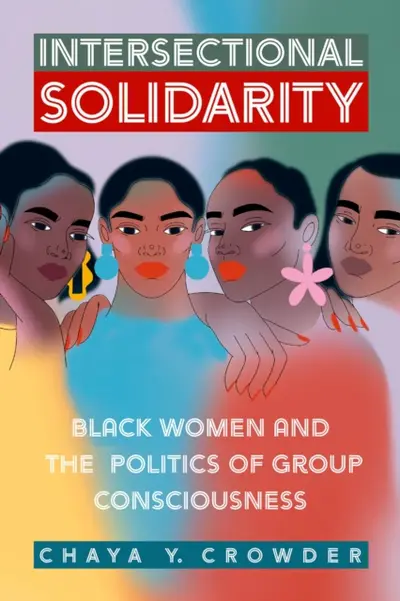
Intersectional Solidarity
Black Women and the Politics of Group Consciousness
Price and availability
$18.99
Available in: Andorra, Austria, Australia, Belgium, Bulgaria, Canada, Switzerland, Cyprus, Czechia, Germany, Denmark, Estonia, Spain, Finland, France, United Kingdom, Guernsey, Greece, Croatia, Hungary, Ireland, Isle of Man, Iceland, Italy, Jersey, Japan, Liechtenstein, Lithuania, Luxembourg, Latvia, Monaco, Malta, Netherlands, Norway, Poland, Portugal, Romania, Sweden, Slovenia, Slovakia, San Marino, United States, Vatican City, South Africa
Stores: US, UK, Canada, EU, Australia.
Sign in to buyThe price is re-checked by the server before payment.
For personal use under the eBook licence.
- Format
- EPUB
- DRM
- Not stated by the publisher
- Language
- English
- Publisher
- Oxford University Press
- Published
- 13 January 2025
- ISBN
- 9780197696569
- Subjects
- Social & political philosophy, Gender studies, gender groups, Comparative politics, Public opinion & polls, JBSF, Comparative politics, JPWA, QDTS
About this book
Black women have been credited for Democratic wins in a number of recent consequential elections. Yet outside of the post-election glow, Black women's interests tend not to attract a great deal of attention from politicians, media, or the public more broadly. In Intersectional Solidarity, Chaya Y. Crowder looks at the question of what prompts people to prioritize issues that affect Black women, and when? In particular, she challenges the notion that racial or gender consciousness alone shape political preferences and instead argues that intersectional group consciousness shapes political behavior. Crowder argues that a combination of race, gender, sexuality, and class-based consciousness influences political behavior, particularly when it comes to issues that affect individuals at the intersection of multiple marginalized identities. Further, she introduces the idea of "e;intersectional solidarity,"e; informed by work in social psychology, political science, and Black feminist theory. Crowder applies intersectional solidarity to all people, regardless of their race, gender, or sexuality, but she uses it particularly to explore what groups demonstrate solidarity with Black women, and why. Intersectional Solidarity demonstrates that in order to fully understand how people come to care about issues that affect Black women, scholars are required to ask new questions.
Bibliographic data © Gardners Books Ltd.