EPUB · English
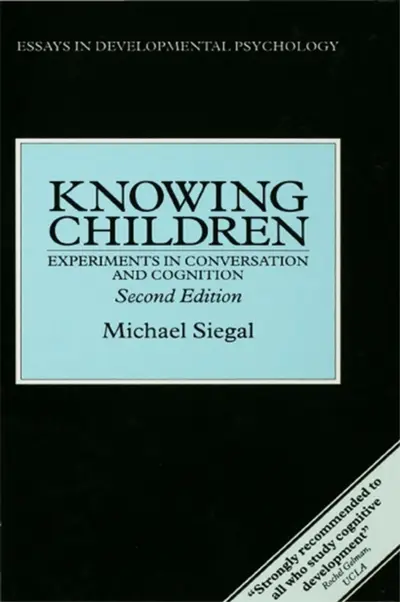
Knowing Children
Experiments in Conversation and Cognition
Price and availability
$79.99
Available in: Andorra, Austria, Australia, Belgium, Bulgaria, Canada, Switzerland, Cyprus, Czechia, Germany, Denmark, Estonia, Spain, Finland, France, United Kingdom, Guernsey, Greece, Croatia, Hungary, Ireland, Isle of Man, Iceland, Italy, Jersey, Japan, Liechtenstein, Lithuania, Luxembourg, Latvia, Monaco, Malta, Netherlands, Norway, Poland, Portugal, Romania, Sweden, Slovenia, Slovakia, San Marino, United States, Vatican City, South Africa
Stores: US, UK, Canada, EU, Australia.
Sign in to buyThe price is re-checked by the server before payment.
For personal use under the eBook licence.
- Format
- EPUB
- DRM
- Not stated by the publisher
- Language
- English
- Publisher
- Taylor & Francis
- Published
- 13 May 2013
- ISBN
- 9781134840496
- Subjects
- Psychology, Child & developmental psychology, Cognition & cognitive psychology, Child, developmental and lifespan psychology, Cognition and cognitive psychology
About this book
It has often been maintained that young children's knowledge is limited to perceptual appearances. In this "e;preoperational"e; stage of development, there are profound conceptual limitations in that they have little understanding of numerical and causal relations and are incapable of insight into the minds of others. Their apparent inability to perform well on traditional developmental measures has led researchers to accept a model of the young child as plagued by conceptual deficits. These ideas have had a major impact on educational programs. Many have accepted the view that the young are not ready for instruction and that their memory and understanding is vulnerable to distortion, especially in subjects such as mathematics and science. However, the second edition of this book provides further evidence that children's stage-like performance can frequently be reinterpreted in terms of a clash between the conversational worlds of adults and children. In many settings, children may not share an adult's well-meaning purpose or use of words in questioning. Under these conditions, they do not disclose the depth of their memory and understanding and may respond incorrectly even when they are certain of the right answer. In this light, a different model of development emerges with significant implications for instruction in educational, health, and legal settings. It attributes more competence to young children than is frequently recognized and reflects the position that development in evolutionarily important domains is guided by implicit constraints on learning. It proposes that attention to young children's conversational experience is a powerful means to illustrate what they know.
Bibliographic data © Gardners Books Ltd.